


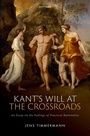
Kant's Will at the Crossroads
An Essay on the Failings of Practical Rationality
Published on 4. August 2022
Book
Hardback
188 pages
978-0-19-289603-2 (ISBN)
Description
What happens when human beings fail to do as reason bids? This book is an attempt to address this age-old question within Kant's mature practical philosophy, i.e. the practical philosophy that emerged with the watershed discovery of autonomy in the mid-1780s. As always, Kant is good for a surprise. There is, it is argued, not one answer but two: He advocates Socratic intellectualism in the realm of prudence whilst defending an anti-intellectualist or volitional account of immoral action.
This 'hybrid' theory of practical failure is more than a philosophical curiosity. There are ramifications for Kant's theory of practical reason as a whole. In particular, the hybrid account emphasizes the divide between pure and empirical practical rationality to the extent that the latter, while containing practically relevant propositions, no longer counts a branch of practical reason at all. Hypothetical and categorical imperatives exemplify two entirely distinct kinds of normativity. In fact, the dichotomy between pure and empirical determining grounds of the will goes hand in hand with many other dualisms and dichotomies that, whether we like them or not, continue to define Kant's mature ethical thought.
This 'hybrid' theory of practical failure is more than a philosophical curiosity. There are ramifications for Kant's theory of practical reason as a whole. In particular, the hybrid account emphasizes the divide between pure and empirical practical rationality to the extent that the latter, while containing practically relevant propositions, no longer counts a branch of practical reason at all. Hypothetical and categorical imperatives exemplify two entirely distinct kinds of normativity. In fact, the dichotomy between pure and empirical determining grounds of the will goes hand in hand with many other dualisms and dichotomies that, whether we like them or not, continue to define Kant's mature ethical thought.
Reviews / Votes
Jens Timmermann's work, Kant's Will at the Crossroads, provocatively and insightfully claims that Kantian moral theory has gone wrong by focusing unduly on cognition, as borne out by the associated talk of 'reasons'. * British Journal for the History of Philosophy * Timmermann develops a distinctive treatment of the principal ideas in Kant's moral psychology and conception of rational agency... Kant's Will at the Crossroad develops a comprehensive approach to Kant's conception of practical rationality supported by careful reading of the principal texts. By re affirming several (familiar) dualisms that other commentators have played down, it lays out an alternative to one influential trend in recent Kant scholarship. These issues are subtle and complex, and we should be grateful to Jens Timmermann for putting them on the table so clearly and giving us the opportunity to think them through once more. * NDPR * Timmermann's work delivers in a way that will surprise many Kant interpreters by challenging certain mainstays of contemporary interpretation...if you want to know more about Kant's ethics, then you absolutely should read this book. * European Journal of Philosophy * Kant's Will at the Crossroads is a fantastic book, elegantly written and a pleasure to read, that advances a single clear argument defending a bold thesis about the nature of practical failure (both prudential and moral). Along the way, the book engages with countless related issues, always with clarity and concision and never as mere tangents...The book is a masterpiece of focused argument for a clear and ultimately simple (in the best sense) interpretation of Kant, even if its simplicity requires overturning what many will see as 'accomplishments' of Kant scholarship over the past fifty years. * Kantian Review * This is a fascinating thesis, developed in an impressive and elegant book. Timmermann makes his case in fewer than 160 pages yet offers detailed analysis across the range of primary texts, as well as engagement with important interlocuters in the secondary literature... Timmermann's arguments have helped me think through some key features of Kant's account of practical reason and challenged me to do so further. This is a book I will be returning to, and one I highly recommend. * Lucy Allais, The Journal of Philosophy *More details
Language
English
Place of publication
Oxford
United Kingdom
Target group
Professional and scholarly
Product notice
sewn/stitched
Cloth over boards
Dimensions
Height: 238 mm
Width: 159 mm
Thickness: 19 mm
Weight
446 gr
ISBN-13
978-0-19-289603-2 (9780192896032)
Copyright in bibliographic data and cover images is held by Nielsen Book Services Limited or by the publishers or by their respective licensors: all rights reserved.
Schweitzer Classification
Other editions
Additional editions
E-Book
07/2022
1st Edition
OUP eBook
€48.99
Available for download
E-Book
07/2022
1st Edition
OUP eBook
€48.99
Available for download
Person
Jens Timmermann is the Professor of Moral Philosophy at the University of St Andrews. He is a leading authority in Immanuel Kant's ethics and is the author of several books on Kant, including Kant's Groundwork of the Metaphysics of Morals: A Commentary (2007) and Sittengesetz und Freiheit (2003). He is also the editor of the first German-English edition of Kant's Groundwork (2011).
Content
Preface
A note on texts and translations
1: Introduction
2: Happiness
3: The law and the good
4: Instrumental imperatives
5: The emergence of practical reason
6: Incentives, maxims, and freedom
7: Two types of practical failure
8: Conclusions and implications
Kant's practical dualisms: a fifteen-point summary
Bibliography
A note on texts and translations
1: Introduction
2: Happiness
3: The law and the good
4: Instrumental imperatives
5: The emergence of practical reason
6: Incentives, maxims, and freedom
7: Two types of practical failure
8: Conclusions and implications
Kant's practical dualisms: a fifteen-point summary
Bibliography