

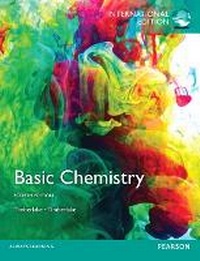
Basic Chemistry
International Edition
4th Edition
Published on 5. February 2013
Book
Paperback/Softback
744 pages
978-0-321-86626-4 (ISBN)
Description
Maintaining the clear, approachable writing style characteristic of author Karen Timberlake, Basic Chemistry, Fourth Edition, adds to its suite of problem-solving tools and techniques necessary for success in chemistry. Engaging new features such as end-of-section Math Practice problems, video tutorials and Math Review Modules allow readers to practice and master quantitative skills. Popular features, including "Combining Ideas" sections and end-of-chapter questions, have also been strengthened and expanded. Modern real-world applications help students connect chemical principles to events in their world, while stories involving careers illustrate the importance of chemistry in future careers.
More details
Edition
4th edition
Language
English
Place of publication
United States
Publishing group
Pearson Education (US)
Target group
College/higher education
Dimensions
Height: 216 mm
Width: 271 mm
Thickness: 22 mm
Weight
1480 gr
ISBN-13
978-0-321-86626-4 (9780321866264)
Copyright in bibliographic data is held by Nielsen Book Services Limited or its licensors: all rights reserved.
Schweitzer Classification
Other editions
New editions
Karen C. Timberlake | William Timberlake
Basic Chemistry: Pearson New International Edition
Book
11/2013
4th Edition
Pearson Education Limited
€68.08
Article exhausted; check for reprint
Previous edition
Book
02/2010
3rd Edition
Pearson
€73.03
Article exhausted; check for reprint
Persons
Karen Timberlake is Professor Emerita of chemistry at Los Angeles Valley College, where she taught chemistry for allied health and preparatory chemistry for 36 years. She received her bachelor's degree in chemistry from the University of Washington and her master's degree in biochemistry from the University of California at Los Angeles.
Professor Timberlake has been writing chemistry textbooks for 35 years. During that time, her name has become associated with the strategic use of pedagogical tools that promote student success in chemistry and the application of chemistry to real-life situations. More than one million students have learned chemistry using texts, laboratory manuals, and study guides written by Karen Timberlake. In addition to Basic Chemistry, Fourth Edition, she is also the author of General, Organic, and Biological Chemistry: Structures of Life, Fourth Edition, and Chemistry: An Introduction to General, Organic, and Biological Chemistry, Eleventh Edition with the accompanying Study Guide, Selected Solutions Manual, Laboratory Manual, and Essential Laboratory Manual.
Professor Timberlake belongs to numerous science and educational organizations including the American Chemical Society (ACS) and the National Science Teachers Association (NSTA). She was the Western Regional Winner of Excellence in College Chemistry Teaching Award given by the Chemical Manufacturers Association. In 2004, she received the McGuffey Award in Physical Sciences from the Text and Academic Authors Association for her textbook Chemistry: An Introduction to General, Organic, and Biological Chemistry, eight edition, which has demonstrated excellence over time. In 2006, she received the Textbook excellence award for the first edition of Basic Chemistry. She has participated in education grants for science teaching including the Los Angeles Collaborative for Teaching Excellence (LACTE) and a Title III grant at her college. She speaks at conferences and educational meetings on the use of student-centered teaching methods in chemistry to promote learning success of students.
Professor Timberlake has been writing chemistry textbooks for 35 years. During that time, her name has become associated with the strategic use of pedagogical tools that promote student success in chemistry and the application of chemistry to real-life situations. More than one million students have learned chemistry using texts, laboratory manuals, and study guides written by Karen Timberlake. In addition to Basic Chemistry, Fourth Edition, she is also the author of General, Organic, and Biological Chemistry: Structures of Life, Fourth Edition, and Chemistry: An Introduction to General, Organic, and Biological Chemistry, Eleventh Edition with the accompanying Study Guide, Selected Solutions Manual, Laboratory Manual, and Essential Laboratory Manual.
Professor Timberlake belongs to numerous science and educational organizations including the American Chemical Society (ACS) and the National Science Teachers Association (NSTA). She was the Western Regional Winner of Excellence in College Chemistry Teaching Award given by the Chemical Manufacturers Association. In 2004, she received the McGuffey Award in Physical Sciences from the Text and Academic Authors Association for her textbook Chemistry: An Introduction to General, Organic, and Biological Chemistry, eight edition, which has demonstrated excellence over time. In 2006, she received the Textbook excellence award for the first edition of Basic Chemistry. She has participated in education grants for science teaching including the Los Angeles Collaborative for Teaching Excellence (LACTE) and a Title III grant at her college. She speaks at conferences and educational meetings on the use of student-centered teaching methods in chemistry to promote learning success of students.
Content
Chapter 1 Chemistry in Our Lives
Chapter 2 Measurements
Chapter 3 Matter and Energy
Chapter 4 Atoms and Elements
Chapter 5 Electronic Structure and Periodic Trends
Chapter 6 Ionic and Molecular Compounds
Chapter 7 Chemical Quantities
Chapter 8 Chemical Reactions
Chapter 9 Chemical Quantities in Reactions
Chapter 10 Properties of Solids and Liquids
Chapter 11 Gases
Chapter 12 Solutions
Chapter 13 Reaction Rates and Chemical Equilibrium
Chapter 14 Acids and Bases
Chapter 15 Oxidation and Reduction
Chapter 16 Nuclear Radiation
Chapter 17 Organic Chemistry
Chapter 18 Biochemistry
Chapter 2 Measurements
Chapter 3 Matter and Energy
Chapter 4 Atoms and Elements
Chapter 5 Electronic Structure and Periodic Trends
Chapter 6 Ionic and Molecular Compounds
Chapter 7 Chemical Quantities
Chapter 8 Chemical Reactions
Chapter 9 Chemical Quantities in Reactions
Chapter 10 Properties of Solids and Liquids
Chapter 11 Gases
Chapter 12 Solutions
Chapter 13 Reaction Rates and Chemical Equilibrium
Chapter 14 Acids and Bases
Chapter 15 Oxidation and Reduction
Chapter 16 Nuclear Radiation
Chapter 17 Organic Chemistry
Chapter 18 Biochemistry