

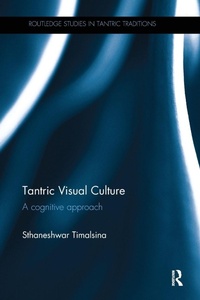
Tantric Visual Culture
A Cognitive Approach
1st Edition
Published on 25. May 2017
Book
Paperback/Softback
190 pages
978-1-138-09846-6 (ISBN)
Description
Indian culture relies greatly on visual expression, and this book uses both classical Indian and contemporary Western philosophies and current studies on cognitive sciences, and applies them to contextualize Tantric visual culture.
The work selects aspects of Tantric language and the practice of visualization, with the central premise to engage cognitive theories while studying images. It utilizes the contemporary theories of metaphor and cognitive blend, the theory of metonymy, and a holographic theory of epistemology with a focus on concept formation and its application to the study of myths and images. In addition, it applies the classical aesthetic theory of rasa to unravel the meaning of opaque images. This philosophical and cognitive analysis allows materials from Indian culture to be understood in a new light, while engaging contemporary theories of cognitive science and semantics. The book demonstrates how the domains of meaning and philosophy can be addressed within any culture without reducing their intrinsic cultural significance.
By addressing these key aspects of Tantric traditions through this approach, this book initiates a much-needed dialogue between Indian and Western theories, while encouraging introspection within the Indic traditions themselves. It will be of interest to those studying and researching Religion, Philosophy and South Asian Culture.
The work selects aspects of Tantric language and the practice of visualization, with the central premise to engage cognitive theories while studying images. It utilizes the contemporary theories of metaphor and cognitive blend, the theory of metonymy, and a holographic theory of epistemology with a focus on concept formation and its application to the study of myths and images. In addition, it applies the classical aesthetic theory of rasa to unravel the meaning of opaque images. This philosophical and cognitive analysis allows materials from Indian culture to be understood in a new light, while engaging contemporary theories of cognitive science and semantics. The book demonstrates how the domains of meaning and philosophy can be addressed within any culture without reducing their intrinsic cultural significance.
By addressing these key aspects of Tantric traditions through this approach, this book initiates a much-needed dialogue between Indian and Western theories, while encouraging introspection within the Indic traditions themselves. It will be of interest to those studying and researching Religion, Philosophy and South Asian Culture.
Reviews / Votes
In this bold and brilliant book, Timalsina brings his formidable scholarship on Tantra to bear on questions regarding the nature and constitution of complex images, the purposes and techniques of visualization, the emotional dimension of abstract liturgical and cognitive processes, and the teleology of bodily discipline. The re-conceptualisation of Tantra in order to open up its potential to comparative philosophical understanding is provocative and thought-provoking; even more striking is the wide-ranging, astonishingly well-grounded and thoroughly original use of the ideas of cognitive linguistics in that endeavour. Not only scholars of Tantra and Hindu Studies more widely, but anyone interested in tackling fundamental philosophical questions about cognition, emotion and body should read this book; there is much benefit to be had from it.Dr. Ram-Prasad Chakravarthi, University of Lancaster, UK
Tantra, often misunderstood, finds illumination in this important book. Dr. Timalsina carefully explains the role of metaphor and metonymy as well as image and experience in this deeply affective exploration of the texts and practices of Tantra. Beautifully illustrated, this book gives access to material that has hitherto been unknown, including new perspectives on visualization through Yantra and Mandala as well as the efficacy and function of Mantra.
Professor Christopher Key Chapple, Loyola Marymount University, USA.
More details
Series
Language
English
Place of publication
London
United Kingdom
Publishing group
Taylor & Francis Ltd
Target group
College/higher education
Illustrations
15 s/w Photographien bzw. Rasterbilder, 4 s/w Tabellen
4 Tables, black and white; 15 Halftones, black and white
Dimensions
Height: 234 mm
Width: 156 mm
Thickness: 11 mm
Weight
301 gr
ISBN-13
978-1-138-09846-6 (9781138098466)
Copyright in bibliographic data and cover images is held by Nielsen Book Services Limited or by the publishers or by their respective licensors: all rights reserved.
Schweitzer Classification
Other editions
Additional editions
E-Book
11/2015
1st Edition
Routledge
€72.49
Available for download
E-Book
11/2015
1st Edition
Routledge
€72.49
Available for download
Book
02/2015
1st Edition
Routledge
€232.80
Shipment within 10-20 days
Person
Sthaneshwar Timalsina is Associate Professor in the Department of Religious Studies at San Diego State University, USA.
Content
Introduction Overview Part 1: Image in the Context of Tantric Practice 1. Mnemonics, Image Compression, and Tantric Visualization Part 2: Image, Metonymy, and Metaphors 2. Image, Metonymy, and Cognition: A Study of Tantric Language 3. Metaphor, Embodiment, and Tantric Images Part 3: Image Compression and Decompression 4. Complex Images in Tantric Visualization: A Cognitive Approach 5. Holographic Limbs and Metaphoric Bodies in Hindu Myths Part 4: Visualization and Emotions 6. Invoking Emotions: Reading Tantric Images in Light of Rasa Theory Part 5: Conclusions 7. Conclusions