

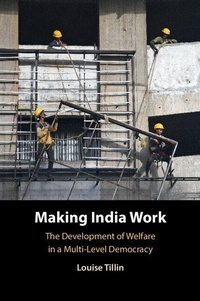
Making India Work
The Development of Welfare in a Multi-Level Democracy
Published on 13. February 2025
Book
Paperback/Softback
248 pages
978-1-009-46435-2 (ISBN)
Description
Welfare politics take centre stage in India's electoral landscape today. Direct benefits and employment generation form the mainstays of social provision, while most citizens lack dependable rights to sickness leave, pensions, maternity benefits or unemployment insurance. But how did this system evolve? Louise Tillin traces the origins and development of India's welfare regime, recovering a history previously relegated to the margins of scholarship on the political economy of development. Her deeply researched analysis, spanning from the early twentieth century to the present, captures long-term patterns of continuity and change against a backdrop of nation-building, economic change, and democratisation. Making India Work demonstrates that while patronage and resource constraints have undermined the provision of public goods, Indian workers, employers, politicians and bureaucrats have long debated what an Indian 'welfare state' should look like. The ideas and principles shaping earlier policies remain influential today.
Reviews / Votes
'Tillin's rich scholarly curiosity explores India's dismal social policies as the outcome of a long history of tensions between social forces and economic and political threats on the one hand and the individual bearers of ideas about social justice and rights on the other, between centralising policy processes and institutions and fissiparous ones - layered and contorted like geological sediments. A great achievement and essential reading.' Barbara Harriss-White, Wolfson College, Oxford 'In this meticulously researched and beautifully written book, Tillin traces the development of welfare in India, placing these dynamics in global and historical context. In a wide-ranging exploration that spans more than a century, from early industrialization, to the Green Revolution, to liberalization and beyond, Tillin examines the economic conditions, policy debates, and political dynamics that shaped welfare regimes over time. Along the way, she demonstrates how work and employment became and remain central to India's approach to social policy, while also showing how electoral competition in a multi-level democracy led to sub-national policy innovations. In illuminating this history, Tillin provides a necessary foundation for an understanding of the unevenness of welfare provision and social development in India today. This is essential reading for scholars, practitioners, and policymakers concerned with questions of social rights and redistribution in India and far beyond.' Gabrielle Kruks-Wisner, University of Virginia 'This is an analytically astute and historically informed account of India's welfare regimes. It is unique in bringing together regional dynamics, electoral competition, social movements, and normative frameworks, in a compelling account of one of the most significant welfare regimes in the world.' Pratap Bhanu Mehta, Center for Policy Research, DelhiMore details
Language
English
Place of publication
Cambridge
United Kingdom
Illustrations
Worked examples or Exercises
Dimensions
Height: 229 mm
Width: 152 mm
Thickness: 14 mm
Weight
365 gr
ISBN-13
978-1-009-46435-2 (9781009464352)
Copyright in bibliographic data and cover images is held by Nielsen Book Services Limited or by the publishers or by their respective licensors: all rights reserved.
Schweitzer Classification
Other editions
Additional editions
Book
02/2025
Cambridge University Press
€107.70
Shipment within 15-20 days
Person
Content
1. Introduction: the shaping of a welfare regime; 2. Origins, expansion and reform: India's welfare regime in historical perspective; Part I. Building a National Economy: Regulating Internal Competition: 3. In the shadow of sickness: Bombay and the origins of social insurance; 4. World war two, Tripartism and a National welfare State for industrial workers; Part II. Putting India to Work: 5. A girding of loins: planning and the duty to work in the postcolonial State; 6. Electoral competition and the expansion of social policy to rural areas: rural employment guarantee as social security; Part III. Liberalisation and Welfare in a Multi-level Democracy: 7. Liberalisation and the 'social safety net'; 8. Welfare, rights and the market in the post-congress polity, 1998-2014; 9. Conclusion: the past and future of the welfare State in India; Bibliography; Index.