

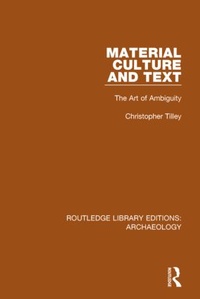
Material Culture and Text
The Art of Ambiguity
1st Edition
Published on 18. October 2016
Book
Paperback/Softback
206 pages
978-1-138-81809-5 (ISBN)
Description
Originally published in 1991, this is the first book-length exploration of post-structuralist discourse theory in archaeology. It tackles the most basic problem of historical and archaeological analysis - the relationship between text and artefact - in an analysis of prehistoric art fusing theory and the practice of interpretation to create a fresh framework for understanding the relationship between past and present. Focusing on a collection of rock carvings from northern Sweden, the author shows how alternative conceptualizations of the material from structuralist, hermeneutic and structural-Marxist frameworks substantially alter our understanding of their meaning and significance. Engaging readers in an interpretive process, this book is for specialists in archaeology, anthropology, art history and cultural studies.
More details
Series
Language
English
Place of publication
London
United Kingdom
Publishing group
Taylor & Francis Ltd
Target group
College/higher education
Dimensions
Height: 234 mm
Width: 156 mm
Weight
380 gr
ISBN-13
978-1-138-81809-5 (9781138818095)
Copyright in bibliographic data and cover images is held by Nielsen Book Services Limited or by the publishers or by their respective licensors: all rights reserved.
Schweitzer Classification
Other editions
Additional editions
E-Book
10/2014
1st Edition
Routledge
€72.49
Available for download
E-Book
10/2014
1st Edition
Routledge
€72.49
Available for download
Book
10/2014
1st Edition
Routledge
€207.40
Shipment within 10-20 days
Person
Content
Preface Part 1: Reading a Material Text 1. Motifs and Rapids 2. Naemforsen Through the Eyes of Hallstroem 3. Locating a Grammar 4. Why Naemforsen? 5. Design Form 6. Mobile Space, Arrested Time 7. Related Texts Part 2: Mediating the Text 8. A Structural Logic 9. An Hermeneutics of Meaning 10. An Analytics of Power 11. Conclusions