

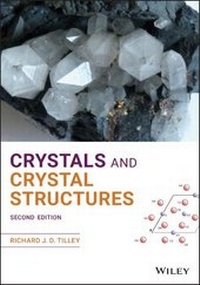
Crystals and Crystal Structures
2nd Edition
Published on 9. July 2020
Book
Paperback/Softback
350 pages
978-1-119-54838-6 (ISBN)
Description
An authoritative, updated text that offers an introduction to crystals and crystal structure with coverage of crystallography, and microscopy of materials
Written in a friendly, non-mathematical style, the updated second edition of Crystals and Crystal Structures offers a comprehensive exploration of the key elements of crystals and crystal structures. Starting with the basics, it includes information on multiple areas of crystallography, including modulated structures, quasicrystals and protein crystallography, and interdisciplinary applications as diverse as the relationship between physical properties and symmetry.
To enhance comprehension of the material presented, the book contains a variety of problems and exercises. The revised second edition offers new material and updates in the field including:
* An introduction to the use of high intensity X-ray analysis of protein structures
* Advances in imaging, scanning electron microscopy, and cryo-electron microscopy
* The relationship between symmetry and physical properties highlighting new findings and an introduction to tensor notation in describing these relationships in a concise fashion
* Nanoparticles as well as crystallographic aspects, defects, surface defects and the impact of these crystallographic features on properties
* Perovskite structures and their variations and the inclusion of their wide-ranging properties
Written for students ofcrystallography, chemistry, physics, materials science, biosciences and geology, Crystals and Crystal Structures, Second Edition provides an understanding of the subject and enables students to read scientific papers and articles describing a crystal structure or use crystallographic databases.
More details
Other editions
Additional editions
Richard J. D. Tilley
Crystals and Crystal Structures
E-Book
05/2020
2nd Edition
Wiley
€85.99
Available for download
Richard J. D. Tilley
Crystals and Crystal Structures
E-Book
05/2020
2nd Edition
Wiley
€85.99
Available for download
Previous edition
Richard J. D. Tilley
Crystals and Crystal Structures
Book
06/2006
Wiley
€202.00
Article exhausted; check for reprint
Person
Richard J. D. Tilley D. Sc, Ph. D, is Emeritus Professor in the School of Engineering at the University of Cardiff, Wales, U.K. He has published extensively in the area of solid-state materials science, including 9 textbooks (translated into multiple languages), 23 chapters and encyclopedia entries and more than 200 journal papers.
Content
Chapter 1 Crystals and crystal structures
1.1 Crystal families and crystal systems
1.2 Unit cells and Miller indices
1.3 The determination of crystal structures
1.4 The description of crystal structures
1.5 Crystal structures: metals
1.5.1 The cubic close-packed (A1) structure of copper
1.5.2 The body-centred cubic (A2) structure of tungsten
1.5.3 The hexagonal (A3) structure of magnesium
1.6 Crystal structures: binary compounds
1.6.1 The halite (rock salt, NaCl) structure
1.6.2 The rutile structure
1.6.3 The fluorite structure
1.7 The cubic perovskite structure
1.8 The structure of urea
1.9 The density of a crystal
Answers to introductory questions
Problems and Exercises
Chapter 2 Lattices, planes and directions
2.1 Two-dimensional lattices
2.2 Unit cells
2.3 The reciprocal lattice in two dimensions
2.4 Three-dimensional lattices
2.5 Rhombohedral, hexagonal and cubic lattices
2.6 Alternative unit cells
2.7 The reciprocal lattice in three dimensions
2.8 Lattice planes and Miller indices
2.9 Hexagonal lattices and Miller-Bravais indices
2.10 Miller indices and planes in crystals
2.11 Directions
2.12 Lattice geometry
Answers to introductory questions
Problems and Exercises
Chapter 3 Two-dimensional patterns and tiling
3.1 The symmetry of an isolated shape: point symmetry
3.2 Rotation symmetry of a plane lattice
3.3 The symmetry of the plane lattices
3.4 The ten plane crystallographic point symmetry groups
3.5 The symmetry of patterns: the 17 plane groups
3.6 Two-dimensional "crystal structures"
3.7 General and special positions
3.8 Tesselations
Answers to introductory questions
Problems and Exercises
Chapter 4 Symmetry in three dimensions
4.1 The symmetry of an object: point symmetry
4.2 Axes of inversion: rotoinversion
4.3 Axes of inversion: rotoreflection
4.4 The Hermann-Mauguin symbols for point groups
4.5 The symmetry of the Bravais lattices
4.6 The crystallographic point groups
Answers to introductory questions
Problems and Exercises
Chapter 5 Symmetry and physical properties
5.1 Properties and symmetry
5.2 Point groups and physical properties
5.3 Specification of physical properties
5.4 Refractive index
5.5 Optical activity
5.5.1 Specific rotation
5.5.2 Optical activity in crystals
5.5.3 Optical activity in homogeneous crystals
5.5.4 Optical activity in crystals containing molecules
5.5.5 Optical activity and chiral molecules
5.5.6 Optical activity, chemical reactivity and symmetry
5.6 The pyroelectric effect
5.6.1 Pyroelectric and ferroelectric crystals
5.6.2 Crystallographic aspects of pyro- and ferroelectric behaviour
5.7 Dielectric properties
5.7.1 Dielectrics
5.7.2 Isotropic materials
5.7.3 Non-isotropic materials
5.9 Magnetic point groups and colour symmetry
Answers to introductory questions
Problems and exercises
Chapter 6 Building crystal structures from lattices and space groups
6.1 Symmetry of three-dimensional patterns: space groups
6.2 The crystallographic space groups
6.3 Space group symmetry symbols
6.4 The graphical representation of the space groups
6.5 Building a structure from a space group: Cs3P7
6.6 The structure of diopside, MgCaSi2O6
6.7 The structure of alanine, C3H7NO2
Answers to introductory questions
Problems and exercises
Chapter 7 Diffraction and crystal structure determination
7.1 The occurrence of diffracted beams: Bragg's law
7.2 The geometry of the diffraction pattern
7.3 Particle size
7.4 The intensities of diffracted beams
7.5 The atomic scattering factor
7.6 The structure factor
7.7 Structure factors and intensities
7.8 Numerical evaluation of structure factors
7.9 Symmetry and reflection intensities
7.10 The temperature factor
7.11 Powder X-ray diffraction
7.12 Neutron diffraction
7.13 Structure determination using X-ray diffraction
7.14 Solving the phase problem
7.15 Electron microscopy
7.15.1 Diffraction patterns and structure images
7.15.2 Diffraction and Fourier transforms
7.16 Protein crystallography
7.16.1 The phase problem
7.16.2 The crystallinity problem: SFX
7.16.3 The crystallinity problem: single particle cryo-EM
Answers to introductory questions
Problems and Exercises
Chapter 8 The depiction of crystal structures
8.1 The size of atoms
8.2 Sphere packing
8.3 Metallic radii
8.4 Ionic radii
8.5 Covalent radii
8.6 Van der Waals radii
8.7 Ionic structures and structure building rules
8.8 The bond valence model
8.9 Structures in terms of non-metal (anion) packing
8.10 Structures in terms of metal (cation) packing
8.11 Cation-centred polyhedral representations of crystals
8.12 Polyhedral representations of crystals and diffusion paths
8.13 Structures as nets
8.14 Organic structures
8.15 Protein structures
8.15.1 Proteins: primary structure
8.15.2 Proteins: secondary, tertiary and quaternary structure
Answers to introductory questions
Problems and Exercises
Chapter 9 Defects, modulated structures and quasicrystals
9.1 Defects and occupancy factors
9.2 Defects and unit cell parameters
9.3 Defects and density
9.4 Modular structures
9.5 Polytypes
9.6 Crystallographic shear (CS) phases
9.7 Planar intergrowths and polysomes
9.8 Incommensurately modulated structures
9.9 Quasicrystals
Answers to introductory questions
Problems and Exercises
Appendices
Appendix 1 Vector addition and subtraction
Appendix 2 Crystallographic data for some inorganic crystal structures
Appendix 3 Schoenflies symbols
Appendix 4 The 230 space groups
Appendix 5 Complex numbers
Appendix 6 Complex amplitudes
Answers to problems and exercises
Bibliography
Formula Index
Subject index