

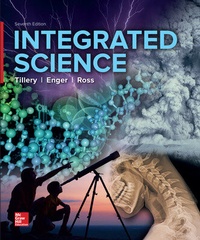
ISE Integrated Science
7th Edition
Published on 20. March 2018
Book
Paperback/Softback
818 pages
978-1-260-08447-4 (ISBN)
Description
Integrated Science, Seventh Edition, is a straightforward, easy-to-read, yet substantial introduction to the fundamental behavior of matter and energy in living and nonliving systems. The authors provide even, well-integrated coverage of physics, chemistry, earth science, astronomy, and biology. The text's pedagogy (chapter outlines, core concept maps, and overviews) reveals how the science disciplines are interrelated and integrated throughout the text.
This edition continues to introduce basic concepts and key ideas while providing opportunities for students to learn reasoning skills and a new way of thinking about their environment.
The book is intended to serve the needs of non-science majors who are required to complete one or more science courses as part of a general or basic studies requirement. No prior work in science is assumed. The language, as well as the mathematics, is as simple as can be practical for a college-level science course.
This edition continues to introduce basic concepts and key ideas while providing opportunities for students to learn reasoning skills and a new way of thinking about their environment.
The book is intended to serve the needs of non-science majors who are required to complete one or more science courses as part of a general or basic studies requirement. No prior work in science is assumed. The language, as well as the mathematics, is as simple as can be practical for a college-level science course.
More details
Edition
7th edition
Language
English
Place of publication
OH
United States
Target group
College/higher education
US School Grade: From College Freshman to College Graduate Student
Illustrations
512 Illustrations
Dimensions
Height: 267 mm
Width: 218 mm
Thickness: 28 mm
Weight
1499 gr
ISBN-13
978-1-260-08447-4 (9781260084474)
Copyright in bibliographic data and cover images is held by Nielsen Book Services Limited or by the publishers or by their respective licensors: all rights reserved.
Schweitzer Classification
Persons
Bill W. Tillery earned a B.A. at Northeastern State University and an M.A. and Ph.D. from the University of Northern Colorado. He is professor emeritus of physics at Arizona State University. Dr. Tillery served as director of the Science and Mathematics Teaching Center at the University of Wyoming and as an assistant professor at Florida State University. Dr. Tillery was honored as Outstanding University Educator at the University of Wyoming and was elected Outstanding Teacher in the Department of Physics and Astronomy at Arizona State University. Dr. Tillery has taught a variety of courses, including general education courses in science and society, physical science, and introduction to physics. He has received more than 40 grants from the National Science Foundation, the U.S. Office of Education, private industry, and private foundations for science curriculum development and science teacher in-service training.
Eldon D. Enger received a B.A. and an M.S. from the University of Michigan. He is professor emeritus of biology at Delta College, where he taught biology, zoology, and environmental science and was active in curriculum and course development. Professor Enger is an advocate for variety in teaching methodology and feels that if students are provided with varied experiences, they are more likely to learn. Professor Enger's classes include writing assignments, student presentation of lecture material, debates by students on controversial issues, field experiences, individual student projects, and discussions of local examples and relevant current events. Professor Enger was a Fulbright Exchange Teacher to Australia and Scotland, received the Bergstein Award for Teaching Excellence and the Scholarly Achievement Award from Delta College, and participated as a volunteer in Earthwatch Research Programs.
Frederick C. Ross received his B.S. and M.S. from Wayne State University. He is professor emeritus of biology at Delta College and has 30 years' teaching experience, including junior and senior high school, during which he has taught biology, cell biology and biological chemistry, microbiology, environmental science, and zoology. Professor Ross has been active in curriculum and course development, including the development of courses in infection control and microbiology, AIDS and infectious diseases, and a PBS ScienceLine course for elementary and secondary education majors in cooperation with Central Michigan University. Professor Ross was involved in the development of the wastewater microbiology technician curriculum offered by Delta College and was actively involved in the National Task Force of Two Year College Biologists (American Institute of Biological Sciences) and in the National Science Foundation College Science Improvement Program.
Eldon D. Enger received a B.A. and an M.S. from the University of Michigan. He is professor emeritus of biology at Delta College, where he taught biology, zoology, and environmental science and was active in curriculum and course development. Professor Enger is an advocate for variety in teaching methodology and feels that if students are provided with varied experiences, they are more likely to learn. Professor Enger's classes include writing assignments, student presentation of lecture material, debates by students on controversial issues, field experiences, individual student projects, and discussions of local examples and relevant current events. Professor Enger was a Fulbright Exchange Teacher to Australia and Scotland, received the Bergstein Award for Teaching Excellence and the Scholarly Achievement Award from Delta College, and participated as a volunteer in Earthwatch Research Programs.
Frederick C. Ross received his B.S. and M.S. from Wayne State University. He is professor emeritus of biology at Delta College and has 30 years' teaching experience, including junior and senior high school, during which he has taught biology, cell biology and biological chemistry, microbiology, environmental science, and zoology. Professor Ross has been active in curriculum and course development, including the development of courses in infection control and microbiology, AIDS and infectious diseases, and a PBS ScienceLine course for elementary and secondary education majors in cooperation with Central Michigan University. Professor Ross was involved in the development of the wastewater microbiology technician curriculum offered by Delta College and was actively involved in the National Task Force of Two Year College Biologists (American Institute of Biological Sciences) and in the National Science Foundation College Science Improvement Program.
Content
Brief TOC Ch 1 What Is Science? Ch 2 Motion Ch 3 Energy Ch 4 Heat and Temperature Ch 5 Wave Motion and Sound Ch 6 Electricity Ch 7 Light Ch 8 Atoms and Periodic Properties Ch 9 Chemical Reactions Ch 10 Water and Solutions Ch 11 Nuclear Reactions Ch 12 The Universe Ch 13 The Solar System Ch 14 Earth in Space Ch 15 Earth Ch 16 Earth's Surface Ch 17 Earth's Weather Ch 18 Earth's Waters Ch 19 Organic and Biochemistry Ch 20 The Nature of Living Things Ch 21 The Origin and Evolution of Life Ch 22 The History of Life on Earth Ch 23 Ecology and Environment Ch 24 Human Biology: Materials Exchange and Control Mechanisms Ch 25 Human Biology: Reproduction Ch 26 Mendelian and Molecular Genetics Appendix A:Mathematical ReviewWorking with EquationsSignificant FiguresConversion of UnitsScientific Notation Appendix B: Solubilities ChartAppendix C: Relative Humidity TableAppendix D: Problem SolvingAppendix E: Solutions for Second Example ExercisesAppendix F: Solutions for Group A Parallel ExercisesGlossaryIndex