

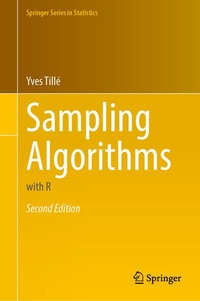
Sampling Algorithms
Description
This book provides a comprehensive overview of innovative sampling methods. Building on the foundations of general sampling theory, it offers a rigorous yet accessible framework for understanding and implementing modern sampling algorithms.
Sampling has undergone a profound transformation since the early 2000s. This new edition has been substantially expanded and offers a far more comprehensive treatment than the first, providing both broader scope and greater depth in modern sampling methodology. It places particular emphasis on state-of-the-art approaches, including systematic and quasi-systematic designs; maximum entropy sampling designs; balanced sampling and its variants; spatial and spread sampling that ensure geographic dispersion for autocorrelated variables; sample coordination for repeated surveys; and sampling from data streams for real-time signal analysis. Sampling enables big data reduction, illustrating how sampling theory can efficiently handle massive datasets.
Each method is presented in detail with an emphasis on practical implementation. Numerous techniques are illustrated using the R programming language, and fully functional code is provided to facilitate immediate application.
This book is intended for master's and doctoral students, as well as experienced statisticians and researchers who already have a good grasp of sampling theory and wish to enrich their toolbox with theory-based, ready-to-implement techniques.
More details
Other editions
Previous edition
Person
Content
Chapter 1 Introduction.- Chapter 2 Milestones and Ideas in Sampling Theory.- Chapter 3 Population, Sample, and Sampling Design.- Chapter 4 Sampling Algorithms.- Chapter 5 Simple Random Sampling.- Chapter 6 Equal Probability Systematic and Quasi-Systematic Sampling.- Chapter 7 Introduction to Unequal Probability Designs.- Chapter 8 Unequal Probability Exponential Designs.- Chapter 9 The Splitting Method.- Chapter 10 More on Unequal Probability Designs.- Chapter 11 Introduction to Balanced Sampling.- Chapter 12 The Cube Method.- Chapter 13 More on the Cube Method.- Chapter 14 Spatial Sampling.- Chapter 15 Sampling from a Stream.- Chapter 16 Sample Coordination.- Chapter 17 Design Choice Under a Superpopulation Mode.