

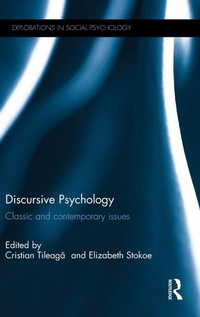
Discursive Psychology
Classic and contemporary issues
1st Edition
Published on 28. August 2015
Book
Hardback
314 pages
978-0-415-72160-8 (ISBN)
Description
Discursive Psychology is the first collection to systematically and critically appraise the influence and development of its foundational studies, exploring central concepts in social psychology such as attitudes, gender, cognition, memory, prejudice, and ideology. The book explores how discursive psychology has accommodated and responded to assumptions contained in classic studies, discussing what can still be gained from a dialogue with these inquiries, and which epistemological and methodological debates are still running, or are worth reviving.
International contributors look back at the original ideas in the classic papers, and consider the impact on and trajectory of subsequent work. Each chapter locates a foundational paper in its academic context, identifying the concerns that motivated the author and the particular perspective that informed their thinking. The contributors go on to identify the main empirical, theoretical or methodological contribution of the paper and its impact on consequent work in discursive psychology, including the contributors' own work. Each chapter concludes with a critical consideration of how discursive psychology can continue to develop.
This book is a timely contribution to the advance of discursive psychology by fostering critical perspectives upon its intellectual and empirical agenda. It will appeal to those working in the area of discursive psychology, discourse analysis and social interaction, including researchers, social psychologists and students.
International contributors look back at the original ideas in the classic papers, and consider the impact on and trajectory of subsequent work. Each chapter locates a foundational paper in its academic context, identifying the concerns that motivated the author and the particular perspective that informed their thinking. The contributors go on to identify the main empirical, theoretical or methodological contribution of the paper and its impact on consequent work in discursive psychology, including the contributors' own work. Each chapter concludes with a critical consideration of how discursive psychology can continue to develop.
This book is a timely contribution to the advance of discursive psychology by fostering critical perspectives upon its intellectual and empirical agenda. It will appeal to those working in the area of discursive psychology, discourse analysis and social interaction, including researchers, social psychologists and students.
More details
Series
Language
English
Place of publication
London
United Kingdom
Publishing group
Taylor & Francis Ltd
Target group
College/higher education
Professional and scholarly
Postgraduate and Professional
Illustrations
2 s/w Tabellen, 2 s/w Zeichnungen, 2 s/w Abbildungen
2 Tables, black and white; 2 Line drawings, black and white; 2 Illustrations, black and white
Dimensions
Height: 240 mm
Width: 161 mm
Thickness: 22 mm
Weight
661 gr
ISBN-13
978-0-415-72160-8 (9780415721608)
Copyright in bibliographic data and cover images is held by Nielsen Book Services Limited or by the publishers or by their respective licensors: all rights reserved.
Schweitzer Classification
Other editions
Additional editions

Book
12/2017
1st Edition
Routledge
€77.10
Shipment within 15-20 days

E-Book
08/2015
Routledge
€69.99
Available for download

E-Book
08/2015
Routledge
€69.99
Available for download
Persons
Cristian Tileaga is Senior Lecturer in Social Psychology in the Department of Social Sciences at Loughborough University, UK.
Elizabeth Stokoe is Professor of Social Interaction in the Department of Social Sciences at Loughborough University, UK.
Elizabeth Stokoe is Professor of Social Interaction in the Department of Social Sciences at Loughborough University, UK.
Content
Introduction: Contemporary Discursive Psychology Cristian Tileaga and Elizabeth Stokoe Part 1: Epistemology and Method Interpretative Repertoires, Conversation Analysis and Being Critical Ann Weatherall. Hitting Ontological Rock Bottom: Discursive psychology's respecification of the realism/relativism debate Clara Iversen. Conversation Analysis and Psychology: Taking up the challenge of Sacks's legacy Alexandra Kent. Natural and Contrived Data Simon Goodman and Susan A. Speer. Questions of Context: Qualitative interviews as a source of knowledge Tim Rapley Part 2: Cognition, Emotion and the Psychological Thesaurus What Happened to Post-cognitive Psychology? Hedwig te Molder. From Loughborough with Love: How discursive psychology rocked the heart of social psychology's love affair with attitudes Sally Wiggins. Discursive Psychology and Emotion Carrie Childs and Alexa Hepburn. Recasting the Psychologist's Question: Children's talk as social action Carly Butler. Seeing the Inside from the Outside of Children's Minds: Displayed understanding and interactional competence Karin Osvaldsson. From Script Theory to Script Formulation: Derek Edwards' shift from perceptual-realism to the interactional-rhetorical Neill Korobov Part 3: Social Categories, Identity and Memory Reorienting Categories as a Members' Phenomena Richard Fitzgerald and Sean Rintel. Some Relevant Things about Gender and Other Categories in Discursive Psychology Sue Widdicombe. Dilemmas of Memory: The mind is not a tape recorder Steve Brown and Paula Reavey. A Forgotten Legacy? Towards a discursive psychology of the media Frederick Attenborough Part 4: Prejudice, Racism and Nationalism Re-theorizing Prejudice in Social Psychology: From cognition to discourse Martha Augoustinos. 'Race Stereotypes' as 'Racist' Discourse Kevin Durrheim. Fact and Evaluation in Racist Discourse Revisited John Dixon and Stephanie Taylor. Banal Nationalism, Postmodernism and Capitalism: Revisiting Billig's critique of Rorty Stephen Gibson