

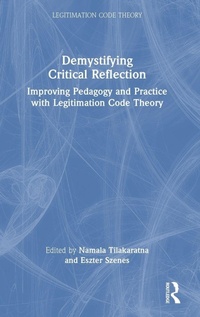
Demystifying Critical Reflection
Improving Pedagogy and Practice with Legitimation Code Theory
1st Edition
Published on 24. January 2024
Book
Hardback
252 pages
978-1-032-01117-2 (ISBN)
Description
Drawing on Legitimation Code Theory (LCT), this volume reveals the knowledge practices and language of critical reflection in a range of different subjects, making clear how it can be taught and learned.
Critical thinking is widely held to be a key attribute required for successfully living, learning and earning in modern societies. Universities now list critical thinking as a key graduate quality and use 'critical reflection' as a way of teaching students how to become reflective and ethical professionals. Yet, what 'critical reflection' actually involves remains vague in research, teaching practice, and assessment. Studies draw on LCT, a fast-growing framework for revealing the knowledge practices that enable educational success and the individual chapters focus on a diverse range of contexts across the disciplinary map, including education, science, arts, sociology and nursing. The book further connects research and practice by presenting in-depth analyses of critical reflection and providing practical insights into how LCT can be used to design pedagogic interventions.
The book offers a rich resource for both scholars and teachers who want to demystify critical reflection and prepare university students for the modern workplace.
Critical thinking is widely held to be a key attribute required for successfully living, learning and earning in modern societies. Universities now list critical thinking as a key graduate quality and use 'critical reflection' as a way of teaching students how to become reflective and ethical professionals. Yet, what 'critical reflection' actually involves remains vague in research, teaching practice, and assessment. Studies draw on LCT, a fast-growing framework for revealing the knowledge practices that enable educational success and the individual chapters focus on a diverse range of contexts across the disciplinary map, including education, science, arts, sociology and nursing. The book further connects research and practice by presenting in-depth analyses of critical reflection and providing practical insights into how LCT can be used to design pedagogic interventions.
The book offers a rich resource for both scholars and teachers who want to demystify critical reflection and prepare university students for the modern workplace.
More details
Series
Language
English
Place of publication
London
United Kingdom
Publishing group
Taylor & Francis Ltd
Target group
College/higher education
Professional and scholarly
Postgraduate and Professional
Illustrations
55 s/w Abbildungen, 55 s/w Photographien bzw. Rasterbilder, 41 s/w Tabellen
41 Tables, black and white; 55 Halftones, black and white; 55 Illustrations, black and white
Dimensions
Height: 240 mm
Width: 161 mm
Thickness: 19 mm
Weight
570 gr
ISBN-13
978-1-032-01117-2 (9781032011172)
Copyright in bibliographic data and cover images is held by Nielsen Book Services Limited or by the publishers or by their respective licensors: all rights reserved.
Schweitzer Classification
Other editions
Additional editions
Namala Tilakaratna | Eszter Szenes
Demystifying Critical Reflection
Improving Pedagogy and Practice with Legitimation Code Theory
E-Book
01/2024
1st Edition
Routledge
€51.49
Available for download
Namala Tilakaratna | Eszter Szenes
Demystifying Critical Reflection
Improving Pedagogy and Practice with Legitimation Code Theory
E-Book
01/2024
1st Edition
Routledge
€51.49
Available for download
Namala Tilakaratna | Eszter Szenes
Demystifying Critical Reflection
Improving Pedagogy and Practice with Legitimation Code Theory
Book
01/2024
1st Edition
Routledge
€58.20
Shipment within 10-20 days
Persons
Namala Tilakaratna is a Senior Lecturer at the Centre for English Language Communication at the National University of Singapore. She has researched and published widely on LCT and SFL approaches to teaching critical thinking across a range of disciplines including social work and nursing.
Eszter Szenes is a Lecturer at the School of Education, The University of Adelaide, Australia, and a Senior Fellow at the Center for Global Resilience and Security, Norwich University, USA. Her research interests include disciplinary and critical digital literacies, critical thinking and information disorder.
Eszter Szenes is a Lecturer at the School of Education, The University of Adelaide, Australia, and a Senior Fellow at the Center for Global Resilience and Security, Norwich University, USA. Her research interests include disciplinary and critical digital literacies, critical thinking and information disorder.
Content
1. Seeing knowledge and knowers in critical reflection: Legitimation Code Theory Part 1: Uncovering critical reflection 2. Developing disciplinary values: Interdisciplinary approaches to investigating critical reflection writing in undergraduate nursing 3. 'I comply but deeply resent being asked to do so': Ethical considerations of assessing students' reflective writing 4. Critical re!ection and critical social work: Describing disciplinary values and knowledge Part 2: Supporting critical reflection in pedagogy 5. Enacting re!ective practice in sport and exercise sciences: Pedagogic and integrative perspectives 6. Consolidating performance: Reflection in the service of developing presentation skills 7. Teaching critical reflection in education diploma pathways: A pedagogic intervention 8. Writing blog critiques in teacher education: Teaching students what is valued with semantic gravity and genre theory 9. Knowledge-powered reflection in teacher education: Semantic waves and genre-based writing practice of museum experiences Part 3: Cultivating critically-reflective students 10. Framing the looking glass: Reflecting constellations of listening for inclusion 11. Football yadayada: Learning how to critically reflect about sport as a social field 12. Understanding students' reflective engagement with academic texts