

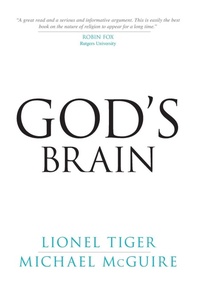
God's Brain
Published on 23. March 2010
Book
Hardback
256 pages
978-1-61614-164-6 (ISBN)
Description
In the fractious debate on the existence of God and the nature of religion, two distinguished authors radically alter the discussion. Taking a perspective rooted in evolutionary biology with a focus on brain science, the authors elucidate the perennial questions about religion: What is its purpose? How did it arise? What is its source? Why does every known culture have some form of it? Their answer is deceptively simple, yet at the same time highly complex: The brain creates religion and its varied concepts of God, and then in turn feeds on its creation to satisfy innate neurological and associated social needs.
Brain science reveals that humans and other primates alike are afflicted by unavoidable sources of stress that the authors describe as "brainpain." To cope with this affliction people seek to "brainsoothe." We humans use religion and its social structures to induce brainsoothing as a relief for innate anxiety. How we do this is the subject of this groundbreaking book.
In a concise, lively, accessible, and witty style, the authors combine zoom-lens vignettes of religious practices with discussions of the latest research on religion's neurological effects on the brain. Among other topics, they consider religion's role in providing positive socialization, its seeming obsession with regulating sex, creating an afterlife, how religion's rules of behavior influence the law, the common biological scaffolding between nonhuman primates and humans and how this affects religion, a detailed look at brain chemistry and how it changes as a result of stress, and evidence that the palliative effects of religion on brain chemistry is not matched by nonreligious remedies.
Concluding with a checklist offering readers a means to compute their own "brainsoothe score," this fascinating book provides key insights into the complexities of our brain and the role of religion, perhaps its most remarkable creation.
Brain science reveals that humans and other primates alike are afflicted by unavoidable sources of stress that the authors describe as "brainpain." To cope with this affliction people seek to "brainsoothe." We humans use religion and its social structures to induce brainsoothing as a relief for innate anxiety. How we do this is the subject of this groundbreaking book.
In a concise, lively, accessible, and witty style, the authors combine zoom-lens vignettes of religious practices with discussions of the latest research on religion's neurological effects on the brain. Among other topics, they consider religion's role in providing positive socialization, its seeming obsession with regulating sex, creating an afterlife, how religion's rules of behavior influence the law, the common biological scaffolding between nonhuman primates and humans and how this affects religion, a detailed look at brain chemistry and how it changes as a result of stress, and evidence that the palliative effects of religion on brain chemistry is not matched by nonreligious remedies.
Concluding with a checklist offering readers a means to compute their own "brainsoothe score," this fascinating book provides key insights into the complexities of our brain and the role of religion, perhaps its most remarkable creation.
More details
Language
English
Place of publication
Amherst
United States
Product notice
Unsewn / adhesive bound
Cloth over boards
With dust jacket
Dimensions
Height: 229 mm
Width: 162 mm
Thickness: 21 mm
Weight
513 gr
ISBN-13
978-1-61614-164-6 (9781616141646)
Copyright in bibliographic data and cover images is held by Nielsen Book Services Limited or by the publishers or by their respective licensors: all rights reserved.
Schweitzer Classification
Persons
Lionel Tiger is the Charles Darwin Professor of Anthropology at Rutgers University. He is also a bestselling author and successful journalist. Michael McGuire is the president of the Biomedical Research Foundation and a former professor of psychiatry and biobehavioural sciences at the University of California at Los Angeles.