

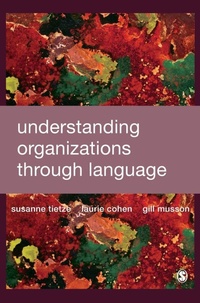
Understanding Organizations through Language
1st Edition
Published on 18. September 2003
Book
Hardback
200 pages
978-0-7619-6718-7 (ISBN)
Description
`Makes fascinating reading and at the same time provides a good grounding in the study of the language of organizations, both for those who know little of the area and for those who are looking for a comprehensive overview of the field. Overall I would warmly recommend this book as an asset for students and teachers of organizational behaviour and for those with a general interest in the way in which language shapes our lives and work'
- Organization Studies
`The book is extremely clear in its explanation of how language works.... The authors treat their readers as curious, intelligent and concerned to find new and powerful tools to come at the workings of organizations from a lateral and newly illuminating perspective' - Virginia Valentine, Semiotic Solutions, London
`The authors are able to apply their personal fascination with language to give students insights into organisational behaviour that significantly surpasses what is normally achieved by the tired old rituals of standard organizational behaviour texts and teaching' - Tony Watson, Nottingham Trent University
Taking issue with functional approaches to communication, Understanding Organizations through Language offers a viable alternative based on `webs of meaning'. Instead of viewing communication as a thing that can be unproblematically controlled and managed, the authors use semiology as a theoretical bedrock to develop a new metaphor for communication. Understanding Organizations through Language applies this approach to areas of interest, including: metaphor, story-telling, discourse, gender, leadership and electronic communication.
Spanning the gap between highly theoretical organization studies texts and highly prescriptive communication texts, the book talks to the reader in a sophisticated yet approachable style. This style is complemented by a range of examples, activities and mini case studies. Also included are chapter summaries and further reading suggestions, making this a useful text for both academics and students.
Advanced undergraduates and postgraduates will utilize this book for any course dealing with communication, particularly courses in HRM and organizational behaviour.
- Organization Studies
`The book is extremely clear in its explanation of how language works.... The authors treat their readers as curious, intelligent and concerned to find new and powerful tools to come at the workings of organizations from a lateral and newly illuminating perspective' - Virginia Valentine, Semiotic Solutions, London
`The authors are able to apply their personal fascination with language to give students insights into organisational behaviour that significantly surpasses what is normally achieved by the tired old rituals of standard organizational behaviour texts and teaching' - Tony Watson, Nottingham Trent University
Taking issue with functional approaches to communication, Understanding Organizations through Language offers a viable alternative based on `webs of meaning'. Instead of viewing communication as a thing that can be unproblematically controlled and managed, the authors use semiology as a theoretical bedrock to develop a new metaphor for communication. Understanding Organizations through Language applies this approach to areas of interest, including: metaphor, story-telling, discourse, gender, leadership and electronic communication.
Spanning the gap between highly theoretical organization studies texts and highly prescriptive communication texts, the book talks to the reader in a sophisticated yet approachable style. This style is complemented by a range of examples, activities and mini case studies. Also included are chapter summaries and further reading suggestions, making this a useful text for both academics and students.
Advanced undergraduates and postgraduates will utilize this book for any course dealing with communication, particularly courses in HRM and organizational behaviour.
More details
Edition
First Edition
Language
English
Place of publication
Thousand Oaks
United States
Target group
College/higher education
Professional and scholarly
Product notice
Cloth over boards
Dimensions
Height: 250 mm
Width: 175 mm
Thickness: 16 mm
Weight
537 gr
ISBN-13
978-0-7619-6718-7 (9780761967187)
Copyright in bibliographic data and cover images is held by Nielsen Book Services Limited or by the publishers or by their respective licensors: all rights reserved.
Schweitzer Classification
Other editions
Additional editions
Susanne Tietze | Laurie Cohen | Gillian Musson
Understanding Organizations through Language
Book
08/2003
1st Edition
SAGE Publications Inc
€95.64
Shipment within 15-20 days
Susanne Tietze | Laurie Cohen | Gillian Musson
Understanding Organizations through Language
E-Book
08/2003
1st Edition
SAGE Publications Ltd
€53.59
Available for download
Susanne Tietze | Laurie Cohen | Gillian Musson
Understanding Organizations through Language
E-Book
08/2003
1st Edition
SAGE Publications Ltd
€113.99
Available for download
Persons
Susanne's first degree, an MA in English and German (first class), was awarded by Karl-Ruprechts-Universitaet, Heidelberg (Germany). She worked as a librarian, properties manager for a theatre company and translator before taking up a teaching scholarship awarded by the Deutscher Akademischer Austauschdienst (German Academic Exchange Service) in 1989 to teach German at Sheffield City Polytechnic
Content
Introduction
Spinning Webs of Meaning
Language and Social Reality
A Semiological Approach to Meaning Making
Understanding Organizations through Metaphor
Understanding Organizations through Stories and Narratives
Understanding Organizations through Discourse
Language, Culture, Meaning
Gender and Language
Leadership and Language
Meaning-Making in the Electronic Age
Spinning Webs of Meaning
Language and Social Reality
A Semiological Approach to Meaning Making
Understanding Organizations through Metaphor
Understanding Organizations through Stories and Narratives
Understanding Organizations through Discourse
Language, Culture, Meaning
Gender and Language
Leadership and Language
Meaning-Making in the Electronic Age