

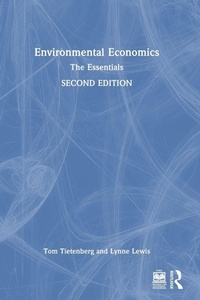
Environmental Economics
The Essentials
2nd Edition
Published on 26. August 2024
Book
Hardback
396 pages
978-1-032-68904-3 (ISBN)
Description
Environmental Economics: The Essentials offers a policy-oriented approach to the increasingly influential field of environmental economics that is based on a solid foundation of economic theory and empirical research. Students will not only leave the course with a firm understanding of environmental economics, but they will also be exposed to a number of case studies showing how underlying economic principles provided the foundation for specific environmental and resource policies. This key text highlights what insights can be derived from the actual experience.
Key features include:
Extensive coverage of the major issues, including climate change, air and water pollution, sustainable development, and environmental justice
Introductions to the theory and method of environmental economics, including externalities, experimental and behavioral economics, benefit-cost analysis, and methods for valuing the services provided by the environment
Boxed Examples and Debates throughout the text, which highlight global cases and major talking points
This second edition provides updated data, new studies, and more international examples. There is a considerable amount of new material, with a deeper focus on climate change. The text is fully supported with end-of-chapter summaries, discussion questions, and self-test exercises in the book, as well as a suite of supplementary digital resources, including multiple-choice questions, simulations, references, slides, and an instructor's manual. It is adapted from the 12th edition of the best-selling Environmental and Natural Resource Economics textbook by the same authors.
Key features include:
Extensive coverage of the major issues, including climate change, air and water pollution, sustainable development, and environmental justice
Introductions to the theory and method of environmental economics, including externalities, experimental and behavioral economics, benefit-cost analysis, and methods for valuing the services provided by the environment
Boxed Examples and Debates throughout the text, which highlight global cases and major talking points
This second edition provides updated data, new studies, and more international examples. There is a considerable amount of new material, with a deeper focus on climate change. The text is fully supported with end-of-chapter summaries, discussion questions, and self-test exercises in the book, as well as a suite of supplementary digital resources, including multiple-choice questions, simulations, references, slides, and an instructor's manual. It is adapted from the 12th edition of the best-selling Environmental and Natural Resource Economics textbook by the same authors.
More details
Edition
2nd edition
Language
English
Place of publication
London
United Kingdom
Publishing group
Taylor & Francis Ltd
Target group
College/higher education
Postgraduate and Undergraduate Advanced
Illustrations
35 s/w Abbildungen, 35 s/w Zeichnungen, 25 s/w Tabellen
25 Tables, black and white; 35 Line drawings, black and white; 35 Illustrations, black and white
Dimensions
Height: 260 mm
Width: 183 mm
Thickness: 27 mm
Weight
977 gr
ISBN-13
978-1-032-68904-3 (9781032689043)
Copyright in bibliographic data and cover images is held by Nielsen Book Services Limited or by the publishers or by their respective licensors: all rights reserved.
Schweitzer Classification
Other editions
Additional editions
Book
08/2024
2nd Edition
Routledge
€151.30
Shipment within 10-20 days
E-Book
08/2024
2nd Edition
Routledge
€115.99
Available for download
E-Book
08/2024
2nd Edition
Routledge
€115.99
Available for download
Previous edition
Tom Tietenberg | Lynne Lewis
Environmental Economics: The Essentials
Book
08/2019
1st Edition
Routledge
€204.27
Article exhausted; check for reprint
Persons
Tom Tietenberg is the Mitchell Family Professor of Economics Emeritus at Colby College, Maine, USA.
Lynne Lewis is Professor, Department of Agricultural and Resource Economics, Colorado State University, Colorado, USA and Elmer W. Campbell Professor of Economics Emeritus at Bates College, Maine, USA.
Lynne Lewis is Professor, Department of Agricultural and Resource Economics, Colorado State University, Colorado, USA and Elmer W. Campbell Professor of Economics Emeritus at Bates College, Maine, USA.
Content
Preface. An Overview of the Book. Acknowledgements. PART I: INTRODUCTION TO THE FIELD OF ENVIRONMENTAL ECONOMICS 1. Visions of the Future 2. The Economic Approach: Property Rights, Externalities, and Environmental Problems 3. Evaluating Trade-Offs: Benefit-Cost Analysis and Other Decision-Making Metrics 4. Valuing the Environment: Methods 5. Economics of Pollution Control: An Overview 6. Stationary-Source Local and Regional Air Pollution PART II: CLIMATE CHANGE AND SUSTAINABLE DEVELOPMENT 7. Climate Change: The Nature of the Challenge 8. Climate Change: Carbon Pricing 9. Transportation: Managing Congestion and Pollution 10. Climate Change: Adaptation: Floods, Wildfires, and Water Scarcity 11. Water Pollution: Managing Water Quality for Rivers, Lakes, and Oceans 12. Toxic Substances and Environmental Justice 13. Sustainable Development: Meeting the Challenge. Answers to Self-Test Exercises. Glossary. Index.