

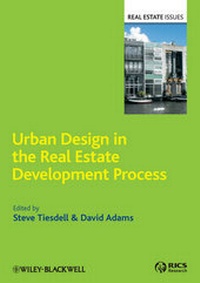
Urban Design in the Real Estate Development Process
Published on 20. May 2011
Book
Hardback
344 pages
978-1-4051-9219-4 (ISBN)
Description
Urban design enables better places to be created for people and is thus seen in Urban Design in the Real Estate Development Process as a place-making activity, rather than the application of architectural aesthetics. Urban design policy can change the 'decision environment' of developers, financiers, designers and other actors in the real estate development process to make them take place-making more seriously.
This book reports diverse international experience from Europe and North America on the role and significance of urban design in the real estate development process and explores how higher quality development and better places can be achieved through public policy.
The book is focused on four types of policy tool or instrument that have been deployed to promote better urban design: those that seek to shape, regulate or provide stimulus to real estate markets along with those aim to build capacity to achieve these. Urban design is therefore seen as a form of public policy that seeks to steer real estate development towards policy-shaped rather than market-led outcomes. The editors set the examples, case studies and evidence from international contributors within a substantive discussion of the impact of urban design policy tools and actions in specific development contexts.
Contributions from leading urban design theorists and practitioners explore how:
* Masterplanning and infrastructure provision encourage high quality design
* Design codes reconcile developers' needs for certainty and flexibility
* Clear policy combined with firm regulation can transform developer behaviour
* Intelligent parcelisation can craft the character of successful new urban districts
* Powerful real estates interests can capture regulatory initiatives
* Stimulus instruments can encourage good design
* Development competitions need careful management
* Design review can foster developer commitment to design excellence
* Speculative housebuilders respond in varied ways to the brownfield design challenge
* Physical-financial models could help in assessing the benefits of design investment
* Urban design can add value to the benefit of developers and cities as a whole.
Reviews / Votes
"David Adams has done a good job in completing the work to give a many-faceted set of insights on urban design in the broadest sense for all those involved in studying, planning and delivering the built environment." (Housing Studies, 2 August 2012)"This edited collection is a pragmatic book exploring various ways of increasing the likelihood that good urban design will result from the interaction of agents involved in the property development process." (Journal of Urban Design, 2 February 2012)
More details
Product info
gebunden
Series
Edition
1. Auflage
Language
English
Place of publication
Hoboken
United Kingdom
Publishing group
John Wiley and Sons Ltd
Target group
Professional and scholarly
Product notice
sewn/stitched
Cloth over boards
Dimensions
Height: 251 mm
Width: 180 mm
Thickness: 23 mm
Weight
900 gr
ISBN-13
978-1-4051-9219-4 (9781405192194)
Schweitzer Classification
Other editions
Additional editions
Steve Tiesdell | David Adams
Urban Design in the Real Estate Development Process
E-Book
04/2011
Wiley-Blackwell
€103.99
Available for download
Steve Tiesdell | David Adams
Urban Design in the Real Estate Development Process
E-Book
03/2011
Wiley-Blackwell
€103.99
Available for download
Persons
Steve Tiesdell, Senior Lecturer in Public Policy, Urban Studies, University of Glasgow
David Adams, Ian Mactaggart Professor of Property and Urban Studies, University of Glasgow
Content
Preface.
Acknowledgements.
Contributors.
1 Real Estate Development, Urban Design and the Tools Approach to Public Policy (Steve Tiesdell and David Adams).
Introduction.
Real estate development.
Opportunity space theory.
The tools approach to public policy.
Shaping instruments.
Regulatory instruments.
Stimulus instruments.
Capacity-building instruments.
Developers' decision environments.
2 Masterplanning and Infrastructure in New Communities in Europe (Nicholas Falk).
Introduction.
Differences between the UK and Europe.
Challenges for sustainable development.
European success stories.
Joined-up planning in the Randstad.
Conclusion: lessons for the UK.
3 Design Coding: Mediating the Tyrannies of Practice (Matthew Carmona).
Introduction.
The three tyrannies.
From development standards to design codes.
The research findings.
Conclusion.
4 Proactive Engagement in Urban Design - The Case of Chelmsford (Tony Hall).
Introduction.
Making the turnaround.
The need for negotiation.
Two examples.
Reflections on the developers' response.
Conclusion.
5 Plot Logic: Character-Building Through Creative Parcelisation (Tim Love and Christina Crawford).
Introduction.
Setting the rules.
Parcelling and subdivision strategies.
The primacy of the urban realm.
The pitfalls of flexibility.
Economic viability of low-scale, densely distributed buildings.
Alternative models.
Conclusion.
6 The Business of Codes: Urban Design Regulation in an Entrepreneurial Society (Nicholas J. Marantz and Eran Ben-Joseph).
Introduction.
Zoning America.
Developing America.
Designing the American future.
Conclusion.
7 Good Design in the Redevelopment of Brownfield Sites (Paul Syms and Andrew Clarke).
Introduction.
Redeveloping and reusing brownfield sites: the policy and regulatory context.
Stimulus instruments in practice.
Conclusion.
8 Competitions as a Component of Design-Led Development (Place) Procurement (Steven Tolson).
Introduction.
The place promoter.
The deliverer and competition participant.
The (end) place matters most.
The competition.
Conclusion.
9 Design Review - An Effective Means of Raising Design Quality? (John Punter).
Introduction.
Origins, emergence and critiques of design review internationally.
The typology of design review in England, Scotland and Wales.
National design review: the genesis of CABE's procedures and processes.
How design review can increase the opportunity space for design.
The effectiveness of design review.
Conclusions: design review and the quality of development control.
10 'Business as Usual?' - Exploring the Design Response of UK Speculative Housebuilders to the Brownfield Development Challenge (David Adams and Sarah Payne).
Introduction.
The design debate around speculative housing development.
The conventional approach to design and construction in speculative housebuilding.
Responding to the challenge of brownfield development.
Conclusion.
11 Physical-Financial Modelling as an Aid to Developers' Decision-Making (John Henneberry, Eckart Lange, Sarah Moore, Ed Morgan and Ning Zhao).
Introduction.
Design quality and development viability.
Visualisation and financial appraisal.
Conclusion.
12 Design Champions - Fostering a Place-Making Culture and Capacity (Steve Tiesdell).
Introduction.
The UK local government context.
The design champion as change agent.
Edinburgh's design champion initiative.
Conclusion.
13 Value Creation Through Urban Design (Gary Hack and Lynne B. Sagalyn).
Introduction.
Design and development projects.
Strategies for enhancing value.
Coupling urban design and development.
14 Connecting Urban Design to Real Estate Development (Steve Tiesdell and David Adams).
Introduction.
Urban design and development economics.
Opportunity space and developer-designer relations.
Policy choices and policy design.
Towards a research agenda.
References.
Index.