

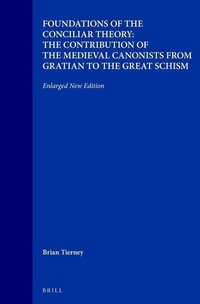
Foundation of the Conciliar Theory
The Contribution of the Medieval Canonists from Gratian to the Great Schism
Published on 1. January 1997
Book
Hardback
XXXII, 255 pages
978-90-04-10924-7 (ISBN)
Description
A major problem which occupied thinkers in the later Middle Ages was the question of the internal structure of the Church and the proper interrelationship of its members. This book is an account of those canonistic theories of Church government which contributed to the growth of the conciliar theory, and which were formulated between Gratian's Decretum (c. 1140) and the Great Schism (1378). It is concerned particularly with the juristic development of the fundamental conciliar doctrine, the assertion that the universal Church was superior to the Church of Rome, with a consequent denial of the Pope's supreme authority.
Foundations of the Conciliar Theory is considered by many to be one of those rare books that significantly influenced twentieth century medieval studies. Now again available in a new enlarged edition, it will continue to be an indispensable work for all those interested in Church history and the Middle Ages.
Foundations of the Conciliar Theory is considered by many to be one of those rare books that significantly influenced twentieth century medieval studies. Now again available in a new enlarged edition, it will continue to be an indispensable work for all those interested in Church history and the Middle Ages.
More details
Series
Edition
Erw. Neuaufl.
Language
English
Place of publication
Leiden
Netherlands
Target group
College/higher education
Professional and scholarly
Product notice
sewn/stitched
Cloth over boards
With dust jacket
Dimensions
Height: 216 mm
Width: 139 mm
Thickness: 15 mm
Weight
209 gr
ISBN-13
978-90-04-10924-7 (9789004109247)
Schweitzer Classification
Person
Brian Tierney, Ph.D. (1951), Cambridge University, is Bryce and Edith M. Bowmar Professor of Humanistic Studies Emeritus at Cornell University. A past president of the American Catholic Historical Association, he has received the honorary degrees of Doctor of Theology (University of Uppsala, Sweden) and Doctor of Letters (Catholic University, Washington, DC).