

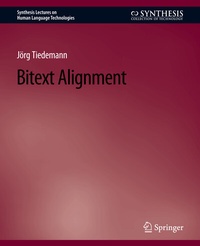
Bitext Alignment
Published on 1. June 2011
Book
Paperback/Softback
XII, 153 pages
978-3-031-01014-9 (ISBN)
Description
This book provides an overview of various techniques for the alignment of bitexts. It describes general concepts and strategies that can be applied to map corresponding parts in parallel documents on various levels of granularity. Bitexts are valuable linguistic resources for many different research fields and practical applications. The most predominant application is machine translation, in particular, statistical machine translation. However, there are various other threads that can be followed which may be supported by the rich linguistic knowledge implicitly stored in parallel resources. Bitexts have been explored in lexicography, word sense disambiguation, terminology extraction, computer-aided language learning and translation studies to name just a few. The book covers the essential tasks that have to be carried out when building parallel corpora starting from the collection of translated documents up to sub-sentential alignments. In particular, it describes various approachesto document alignment, sentence alignment, word alignment and tree structure alignment. It also includes a list of resources and a comprehensive review of the literature on alignment techniques. Table of Contents: Introduction / Basic Concepts and Terminology / Building Parallel Corpora / Sentence Alignment / Word Alignment / Phrase and Tree Alignment / Concluding Remarks
More details
Series
Language
English
Place of publication
Cham
Switzerland
Publishing group
Springer International Publishing
Target group
Professional and scholarly
Illustrations
XII, 153 p.
Dimensions
Height: 235 mm
Width: 191 mm
Thickness: 10 mm
Weight
327 gr
ISBN-13
978-3-031-01014-9 (9783031010149)
DOI
10.1007/978-3-031-02142-8
Schweitzer Classification
Other editions
Additional editions
Person
Jörg Tiedemann is currently employed as a visiting professor of computational linguistics at the Department of Linguistics and Philology at Uppsala University,Sweden.He got his Ph.D.from the same department in 2003. His work is mainly focused on machine translation, question answering and data mining from multilingual resources. He has initiated and still maintains a freely available collection of parallel corpora (OPUS), which is widely used and appreciated.
Content
Introduction.- Basic Concepts and Terminology.- Building Parallel Corpora.- Sentence Alignment.- Word Alignment.- Phrase and Tree Alignment.- Concluding Remarks.