

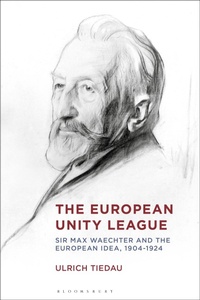
The European Unity League
Sir Max Waechter and the European Idea, 1904-1924
Will be published approx. on 9. July 2026
Book
Hardback
344 pages
978-1-350-27329-0 (ISBN)
Description
This book uncovers a largely forgotten early vision of European unity that emerged in Britain before the First World War. By tracing the remarkable career of Sir Max Waechter (1837-1924), entrepreneur, philanthropist and the British representative of the Nobel brothers' Caspian oil interests, it reveals how British actors were among the earliest in arguing that Europe's growing rivalries could be addressed through closer economic cooperation and political understanding. The study shows that ideas of a federated Europe were already being energetically developed, debated and promoted before 1914.
Central to the book is Waechter's creation of the European Unity League, whose ambitious programme provides a fresh lens to reassess the intellectual and political climate of the pre-war years. Drawing on extensive archival research, the volume reconstructs Waechter's 1906 manifesto to King Edward VII, his extraordinary diplomatic tour across the continent aboard the former Austrian archducal yacht Rovenska and his ability to secure audiences with most reigning heads of state, despite opposition from the Foreign Office. It follows how these efforts led to the 1909 Inaugural Congress of the European Federation in Rome, co-organized with the like-minded Italian pacifist Prince di Cassano (1855-1926), and the formal establishment of the League in London in 1913.
Within fifteen months, the organization attracted 20,000 members, including a tenth of Parliament, senior military figures and a future Prime Minister. Although the outbreak of war curtailed its activities, the League stands as one of the earliest mass movements for European unity, anticipating Richard von Coudenhove-Kalergi's better-known interwar Pan-European Union by two decades and a world war.
By situating Waechter's campaign within broader British and European debates about armaments, decline and the future of the continent, the book offers a new understanding of the roots of the European idea and of Britain's unexpected role in shaping it. Written accessibly, it will appeal to readers interested in modern European history, international politics and the life of a visionary yet overlooked figure.
Central to the book is Waechter's creation of the European Unity League, whose ambitious programme provides a fresh lens to reassess the intellectual and political climate of the pre-war years. Drawing on extensive archival research, the volume reconstructs Waechter's 1906 manifesto to King Edward VII, his extraordinary diplomatic tour across the continent aboard the former Austrian archducal yacht Rovenska and his ability to secure audiences with most reigning heads of state, despite opposition from the Foreign Office. It follows how these efforts led to the 1909 Inaugural Congress of the European Federation in Rome, co-organized with the like-minded Italian pacifist Prince di Cassano (1855-1926), and the formal establishment of the League in London in 1913.
Within fifteen months, the organization attracted 20,000 members, including a tenth of Parliament, senior military figures and a future Prime Minister. Although the outbreak of war curtailed its activities, the League stands as one of the earliest mass movements for European unity, anticipating Richard von Coudenhove-Kalergi's better-known interwar Pan-European Union by two decades and a world war.
By situating Waechter's campaign within broader British and European debates about armaments, decline and the future of the continent, the book offers a new understanding of the roots of the European idea and of Britain's unexpected role in shaping it. Written accessibly, it will appeal to readers interested in modern European history, international politics and the life of a visionary yet overlooked figure.
Reviews / Votes
An extremely thorough account of the life and times of Sir Max Waechter, based on very extensive archive research in many countries, including a chapter on the 'popular' book and newspaper trade at the time, and a business history of the early oil industry. Amongst the myriad of societies and conferences promoting European union before and after the First World War, Waechter's work is seldom more than mentioned, and Tiedau's study shows how important the British contribution was to those international debates. * Michael Wintle, University of Amsterdam, the Netherlands *More details
Language
English
Place of publication
London
United Kingdom
Publishing group
Bloomsbury Publishing PLC
Target group
College/higher education
Product notice
sewn/stitched
Cloth over boards
With dust jacket
Illustrations
15 bw illus
Dimensions
Height: 234 mm
Width: 156 mm
Thickness: 30 mm
Weight
454 gr
ISBN-13
978-1-350-27329-0 (9781350273290)
Copyright in bibliographic data and cover images is held by Nielsen Book Services Limited or by the publishers or by their respective licensors: all rights reserved.
Schweitzer Classification
Other editions
Additional editions
E-Book
06/2026
Bloomsbury Academic
€94.49
Available for download
E-Book
06/2026
Bloomsbury Academic
€94.49
Available for download
Person
Ulrich Tiedau is Professor of European History at University College London (UCL) and an Associate Director of the UCL Centre for Digital Humanities. Recent publications include Pieter Geyl and Britain (with Stijn van Rossem, 2022).
Content
1. Introduction
2. Sir Max Waechter's early life and career in business (1837-1904)
3. The European Unity League (1904-24)
4. Literary Propaganda for the European Unity League (1912-14)
5. The First Congress of the European Federation, Rome 1909
6. The European Unity League's afterlife
7. The British Grandfather of the European Movement
8. Epilogue
Appendix: Selected documents
Notes
Archival Sources
Works Cited
Index
2. Sir Max Waechter's early life and career in business (1837-1904)
3. The European Unity League (1904-24)
4. Literary Propaganda for the European Unity League (1912-14)
5. The First Congress of the European Federation, Rome 1909
6. The European Unity League's afterlife
7. The British Grandfather of the European Movement
8. Epilogue
Appendix: Selected documents
Notes
Archival Sources
Works Cited
Index