

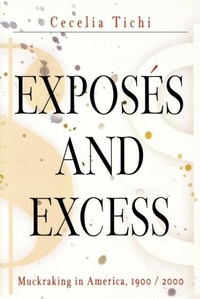
Exposes and Excess
Muckraking in America, 1900 / 2000
Published on 27. April 2005
Book
Paperback/Softback
248 pages
978-0-8122-1926-5 (ISBN)
Description
From robber barons to titanic CEOs, from the labor unrest of the 1880s to the mass layoffs of the 1990s, two American Gilded Ages-one in the early 1900s, another in the final years of the twentieth century-mirror each other in their laissez-faire excess and rampant social crises. Both eras have ignited the civic passions of investigative writers who have drafted diagnostic blueprints for urgently needed change. The compelling narratives of the muckrakers-Upton Sinclair, Ida Tarbell, Lincoln Steffens, and Ray Stannard Baker among them-became bestsellers and prizewinners a hundred years ago; today, Cecelia Tichi notes, they have found their worthy successors in writers such as Barbara Ehrenreich, Eric Schlosser, and Naomi Klein.
In ExposEs and Excess Tichi explores the two Gilded Ages through the lens of their muckrakers. Drawing from her considerable and wide-ranging work in American studies, Tichi details how the writers of the first muckraking generation used fact-based narratives in magazines such as McClure's to rouse the U.S. public to civic action in an era of unbridled industrial capitalism and fear of the immigrant "dangerous classes." Offering a damning cultural analysis of the new Gilded Age, Tichi depicts a booming, insecure, fortress America of bulked-up baby strollers, McMansion housing, and an obsession with money-as-lifeline in an era of deregulation, yawning income gaps, and idolatry of the market and its rock-star CEOs.
No one has captured this period of corrosive boom more acutely than the group of nonfiction writers who burst on the scene in the late 1990s with their exposEs of the fast-food industry, the world of low-wage work, inadequate health care, corporate branding, and the multibillion-dollar prison industry. And nowhere have these authors-Ehrenreich, Schlosser, Klein, Laurie Garrett, and Joseph Hallinan-revealed more about their emergence as writers and the connections between journalism and literary narrative than in the rich and insightful interviews that round out the book.
With passion and wit, ExposEs and Excess brings a literary genre up to date at a moment when America has gone back to the future.
In ExposEs and Excess Tichi explores the two Gilded Ages through the lens of their muckrakers. Drawing from her considerable and wide-ranging work in American studies, Tichi details how the writers of the first muckraking generation used fact-based narratives in magazines such as McClure's to rouse the U.S. public to civic action in an era of unbridled industrial capitalism and fear of the immigrant "dangerous classes." Offering a damning cultural analysis of the new Gilded Age, Tichi depicts a booming, insecure, fortress America of bulked-up baby strollers, McMansion housing, and an obsession with money-as-lifeline in an era of deregulation, yawning income gaps, and idolatry of the market and its rock-star CEOs.
No one has captured this period of corrosive boom more acutely than the group of nonfiction writers who burst on the scene in the late 1990s with their exposEs of the fast-food industry, the world of low-wage work, inadequate health care, corporate branding, and the multibillion-dollar prison industry. And nowhere have these authors-Ehrenreich, Schlosser, Klein, Laurie Garrett, and Joseph Hallinan-revealed more about their emergence as writers and the connections between journalism and literary narrative than in the rich and insightful interviews that round out the book.
With passion and wit, ExposEs and Excess brings a literary genre up to date at a moment when America has gone back to the future.
Reviews / Votes
"Rich and nuanced readings of works by muckrakers at both ends of the twentieth century."-Daniel Horowitz, Smith College"A quietly eloquent intervention in contemporary critical practice."-American Literature
"Tichi provides rich and nuanced readings of works by muckrakers at both ends of the twentieth century, plus a stunning cultural analysis of the booming, insecure world in the U.S., c. 1980-2000. She shows what it means to think of noncanonical texts in multiple ways, including those shaped by literary theory. Finally, she offers wonderful insights into the process by which journalists emerge as writers, and into the problematic differences between journalism and literature."-Daniel Horowitz, Smith College
"Tichi shows us the art of muckraking narrative, and how artful it must be. She shows us, too, the state we are in as a society. The cumulative evidence constitutes a devastating critique of where we are as a culture, where we are in the world, and where we are going. Tichi writes with exuberance, but if we take her seriously, this is a profoundly troubling book."-Miles Orvell, Temple University
"Tichi makes it clear that she sometimes becomes depressed at the corruption and insensitivity raining down from the top of U.S. society, including the White House, and would like to see more journalists exposing problems. But despite legitimate reasons for concern, her book is largely an affirmation of contemporary investigative journalism. And that's good news."-Christian Science Monitor
"Intriguing. . . . Tichi has a firm grasp on contemporary culture in the very early and late 1900s. . . . As much contemporary culture and sociology as journalism."-Choice
More details
Series
Language
English
Place of publication
Pennsylvania
United States
Target group
College/higher education
Professional and scholarly
Product notice
Paperback (trade)
Illustrations
14 illus.
Dimensions
Height: 224 mm
Width: 150 mm
Thickness: 18 mm
Weight
363 gr
ISBN-13
978-0-8122-1926-5 (9780812219265)
Copyright in bibliographic data and cover images is held by Nielsen Book Services Limited or by the publishers or by their respective licensors: all rights reserved.
Schweitzer Classification
Other editions
Additional editions
E-Book
03/2013
1st Edition
University of Pennsylvania Press
€28.99
Available for download
Person
Cecelia Tichi is William R. Kenan, Jr. Professor of English, Vanderbilt University, and has served as president of the American Studies Association. Among her books are Embodiment of a Nation: Human Form in American Places and High Lonesome: The American Culture of Country Music.
Content
Chapter 1. From The Jungle to Fast Food Nation: American Deja Vu
Chapter 2. Bulked Up, Hollowed Out: Looking Backward, Looking Forward
Chapter 3. Muckrakers c. 1900: Civic Passions, "Righteous Indignation"
Chapter 4. Muckrakers c. 2000
-Barbara Ehrenreich, Nickel and Dimed:On (Not) Getting By in America
-Eric Schlosser, Fast Food Nation: The Dark Side of the All-American Meal
-Naomi Klein, No Logo: Taking Aim at the Brand Bullies
-Laurie Garrett, Betrayal of Trust: The Collapse of Global Public Health
-Joseph T. Hallinan, Going Up the River: Travels in a Prison Nation
Epilogue: Tipping Point, or the Long Goodbye?
Bibliography
Index
Acknowledgments
Chapter 2. Bulked Up, Hollowed Out: Looking Backward, Looking Forward
Chapter 3. Muckrakers c. 1900: Civic Passions, "Righteous Indignation"
Chapter 4. Muckrakers c. 2000
-Barbara Ehrenreich, Nickel and Dimed:On (Not) Getting By in America
-Eric Schlosser, Fast Food Nation: The Dark Side of the All-American Meal
-Naomi Klein, No Logo: Taking Aim at the Brand Bullies
-Laurie Garrett, Betrayal of Trust: The Collapse of Global Public Health
-Joseph T. Hallinan, Going Up the River: Travels in a Prison Nation
Epilogue: Tipping Point, or the Long Goodbye?
Bibliography
Index
Acknowledgments