

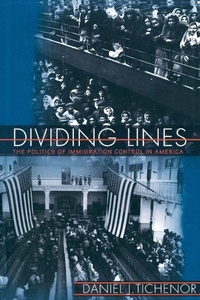
Dividing Lines
The Politics of Immigration Control in America
Will be published approx. on 26. May 2002
Book
Paperback/Softback
400 pages
978-0-691-08805-1 (ISBN)
Description
Immigration is perhaps the most enduring and elemental leitmotif of America. This book is the most powerful study to date of the politics and policies it has inspired, from the founders' earliest efforts to shape American identity to today's revealing struggles over Third World immigration, noncitizen rights, and illegal aliens. Weaving a robust new theoretical approach into a sweeping history, Daniel Tichenor ties together previous studies' idiosyncratic explanations for particular, pivotal twists and turns of immigration policy. He tells the story of lively political battles between immigration defenders and doubters over time and of the transformative policy regimes they built. Tichenor takes us from vibrant nineteenth-century politics that propelled expansive European admissions and Chinese exclusion to the draconian restrictions that had taken hold by the 1920s, including racist quotas that later hampered the rescue of Jews from the Holocaust. American global leadership and interest group politics in the decades after World War II, he argues, led to a surprising expansion of immigration opportunities.
In the 1990s, a surge of restrictionist fervor spurred the political mobilization of recent immigrants. Richly documented, this pathbreaking work shows that a small number of interlocking temporal processes, not least changing institutional opportunities and constraints, underlie the turning tides of immigration sentiments and policy regimes. Complementing a dynamic narrative with a host of helpful tables and timelines, Dividing Lines is the definitive treatment of a phenomenon that has profoundly shaped the character of American nationhood.
In the 1990s, a surge of restrictionist fervor spurred the political mobilization of recent immigrants. Richly documented, this pathbreaking work shows that a small number of interlocking temporal processes, not least changing institutional opportunities and constraints, underlie the turning tides of immigration sentiments and policy regimes. Complementing a dynamic narrative with a host of helpful tables and timelines, Dividing Lines is the definitive treatment of a phenomenon that has profoundly shaped the character of American nationhood.
Reviews / Votes
Winner of the Gladys M. Kammerer AwardMore details
Series
Language
English
Place of publication
New Jersey
United States
Target group
Professional and scholarly
College/higher education
Product notice
Paperback (trade)
Dimensions
Height: 234 mm
Width: 156 mm
Thickness: 23 mm
Weight
672 gr
ISBN-13
978-0-691-08805-1 (9780691088051)
Copyright in bibliographic data and cover images is held by Nielsen Book Services Limited or by the publishers or by their respective licensors: all rights reserved.
Schweitzer Classification
Other editions
Additional editions
E-Book
05/2019
1st Edition
Princeton University Press
€36.99
Available for download
Book
05/2002
Princeton University Press
€108.94
Article exhausted; check different version
Person
Daniel J. Tichenor is Assistant Professor of Political Science at Rutgers University. He has published extensively in leading journals on immigration policy.
Content
List of Tables and Figures ix Acknowledgments xi Chapter One: Introduction 1 Chapter Two: The Politics of Immigration Control: Understanding the Rise and Fall of Policy Regimes 16 Chapter Three: Immigrant Voters in a Partisan Polity: European Settlers, Nativism, and American Immigration Policy, 1776-1896 46 Chapter Four: Chinese Exclusion and Precocious State-Building in the Nineteenth-Century American Polity 87 Chapter Five: Progressivism, War, and Scientific Policymaking: The Rise of the National Origins Quota System, 1900-1928 114 Chapter Six: Two-Tiered Implementation: Jewish Refugees, Mexican Guestworkers, and Administrative Politics 150 Chapter Seven: Strangers in Cold War America: The Modern Presidency, Committee Barons, and Postwar Immigration Politics 176 Chapter Eight: The Rebirth of American Immigration: The Rights Revolution, New Restrictionism, and Policy Deadlock 219 Chapter Nine: Two Faces of Expansion: The Contemporary Politics of Immigration Reform 242 Chapter Ten: Conclusion 289 Appendix: The Sample of Interviewees 297 Notes 299 Index 361