

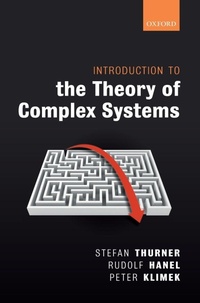
Introduction to the Theory of Complex Systems
Published on 4. October 2018
Book
Hardback
448 pages
978-0-19-882193-9 (ISBN)
Description
This book is a comprehensive introduction to quantitative approaches to complex adaptive systems. Practically all areas of life on this planet are constantly confronted with complex systems, be it ecosystems, societies, traffic, financial markets, opinion formation and spreading, or the internet and social media. Complex systems are systems composed of many elements that interact strongly with each other, which makes them extremely rich dynamical systems showing a huge range of phenomena. Properties of complex systems that are of particular importance are their efficiency, robustness, resilience, and proneness to collapse.
The quantitative tools and concepts needed to understand the co-evolutionary nature of networked systems and their properties are challenging. The book gives a self-contained introduction to these concepts, so that the reader will be equipped with a toolset that allows them to engage in the science of complex systems. Topics covered include random processes of path-dependent processes, co-evolutionary dynamics, dynamics of networks, the theory of scaling, and approaches from statistical mechanics and information theory. The book extends beyond the early classical literature in the field of complex systems and summarizes the methodological progress made over the past 20 years in a clear, structured, and comprehensive way.
The quantitative tools and concepts needed to understand the co-evolutionary nature of networked systems and their properties are challenging. The book gives a self-contained introduction to these concepts, so that the reader will be equipped with a toolset that allows them to engage in the science of complex systems. Topics covered include random processes of path-dependent processes, co-evolutionary dynamics, dynamics of networks, the theory of scaling, and approaches from statistical mechanics and information theory. The book extends beyond the early classical literature in the field of complex systems and summarizes the methodological progress made over the past 20 years in a clear, structured, and comprehensive way.
Reviews / Votes
Well written and structured * Ejay Nsugbe, Mathematics Today * The authors make an excellent job in describing their introduction to Complex Systems theory . . . The book is certainly an excellent start for students (who can find also a series of exercises in every chapter and for practioners). For scientists it is a useful handbook to find whatever needed to start their journey in Complexity Science. * Guido Caldarelli, IMT Alti Studi Lucca, Mathematics Magazine * It seems to me that the authors have succeeded admirably in their aims and that, by helping to train and enthuse the next generation of researchers on complex systems, their book will contribute substantially towards overcoming any possible bottleneck that is impeding further progress. * Peter V. E. McClintock, Department of Physics, Lancaster University, Contemporary Physics * This book is a comprehensive introduction to quantitative approaches to complex adaptive systems, starting from basic principles. It also equips the reader with a basic self-contained toolkit for engaging in complex systems science. It extends earlier classical literature in the field to summarize in a clear, structured, and comprehensive way the methodological progress made in complex systems science over the past 20 years. * Mathematical Reviews Clippings * This book will surely become a standard text for anyone who wants to seriously understand complexity no matter what their background or stage of career. It is written from a physicists perspective, stressing mechanism, underlying principles and mathematical rigour, yet is eminently readable and pedagogical. * Geoffrey West, Santa Fe Institute * Complexity until now has been lacking a strong theoretical underpinning. Now it has one. This book is a tour de force. Excellent! * W. Brian Arthur, Santa Fe Institute *More details
Language
English
Place of publication
Oxford
United Kingdom
Target group
College/higher education
Adult education
Dimensions
Height: 250 mm
Width: 175 mm
Thickness: 28 mm
Weight
944 gr
ISBN-13
978-0-19-882193-9 (9780198821939)
Copyright in bibliographic data and cover images is held by Nielsen Book Services Limited or by the publishers or by their respective licensors: all rights reserved.
Schweitzer Classification
Other editions
Additional editions
Stefan Thurner | Rudolf Hanel | Peter Klimek
Introduction to the Theory of Complex Systems
E-Book
09/2018
1st Edition
OUP eBook
€67.49
Available for download
Persons
Stefan Thurner is full professor for Science of Complex Systems at the Medical University of Vienna, where he chairs the Section for Science of Complex Systems. He is external professor at the Santa Fe Institute, senior researcher at IIASA, and president of the Complexity Science Hub Vienna. He obtained a PhD in theoretical physics from the Technical University of Vienna and a PhD in economics from the University of Vienna. He held postdoctoral positions at Humboldt Universitaet zu Berlin and Boston University before joining the faculty of the University of Vienna and later Medical University. Stefan started his career with contributions to theoretical particle physics and gradually shifted his research focus to the understanding of complex systems. He is the author of more than 200 scientific articles.
Peter Klimek is Associate Professor at the Section for Science of Complex Systems at the Medical University of Vienna and faculty member of the Complexity Science Hub Vienna. His research interests include network medicine, complexity economics, modelling of collective socio-economic phenomena, electoral fraud detection, as well as novel methods to measure systemic risk.
Rudolf Hanel is Associate Professor at the Section for Science of Complex Systems at the Medical University of Vienna and faculty member of the Complexity Science Hub Vienna. His research interests range from applications in medical physics to theoretical work on the behaviour of driven regulatory systems with a focus on mathematical issues.
Peter Klimek is Associate Professor at the Section for Science of Complex Systems at the Medical University of Vienna and faculty member of the Complexity Science Hub Vienna. His research interests include network medicine, complexity economics, modelling of collective socio-economic phenomena, electoral fraud detection, as well as novel methods to measure systemic risk.
Rudolf Hanel is Associate Professor at the Section for Science of Complex Systems at the Medical University of Vienna and faculty member of the Complexity Science Hub Vienna. His research interests range from applications in medical physics to theoretical work on the behaviour of driven regulatory systems with a focus on mathematical issues.
Content
1: Introduction to complex systems
2: Probability and random processes
3: Scaling
4: Networks
5: Evolutionary processes
6: Statistical mechanics & information theory for complex systems
7: The future of the science of complex systems?
8: Special functions and approximations
2: Probability and random processes
3: Scaling
4: Networks
5: Evolutionary processes
6: Statistical mechanics & information theory for complex systems
7: The future of the science of complex systems?
8: Special functions and approximations