

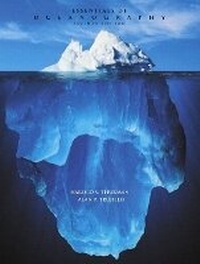
Essentials of Oceanography
7th Edition
Published on 28. November 2001
Book
Paperback/Softback
524 pages
978-0-13-065235-5 (ISBN)
Description
For use in an introductory college-level course in oceanography.
This insightful presentation of the relationship of scientific principles to ocean phenomena is made even more relevant in the Seventh Edition with an enhanced focus on how the oceans interact with other Earth systems. This systems approach-along with student-friendly writing, an excellent graphics package, and a text-specific Companion Website-will intrigue students and ensure they have all the tools necessary to understand how the oceans work.
This insightful presentation of the relationship of scientific principles to ocean phenomena is made even more relevant in the Seventh Edition with an enhanced focus on how the oceans interact with other Earth systems. This systems approach-along with student-friendly writing, an excellent graphics package, and a text-specific Companion Website-will intrigue students and ensure they have all the tools necessary to understand how the oceans work.
More details
Edition
7th edition
Language
English
Place of publication
United States
Publishing group
Pearson Education (US)
Target group
Professional and scholarly
Dimensions
Height: 276 mm
Width: 208 mm
Thickness: 17 mm
Weight
1085 gr
ISBN-13
978-0-13-065235-5 (9780130652355)
Copyright in bibliographic data and cover images is held by Nielsen Book Services Limited or by the publishers or by their respective licensors: all rights reserved.
Schweitzer Classification
Other editions
New editions
Daniel C. Abel | Robert L. McConnell
Essentials of Oceanography
Book
09/2004
8th Edition
Pearson
€55.70
Article exhausted; check for reprint
Previous edition

Harold V. Thurman | Alan P. Trujillo
Essentials of Oceanography
Book
01/1999
6th Edition
Pearson
€40.84
Article exhausted; check for reprint
Persons
Hal Thurman retired in May 1994 after 24 years of teaching in the Earth Sciences Department of Mt. San Antonio College in Walnut, California. Interest in geology led to a bachelor's degree from Oklahoma A&M University, followed by seven years working as a petroleum geologist, mainly in the Gulf of Mexico. Here his interest in oceans developed, and he earned a master's degree from California State University at Los Angeles, then joined the Earth Sciences faculty at Mt. San Antonio College. Hal Thurman is also the author of Introductory Oceanography and has co-authored a marine biology textbook, written articles on the Pacific, Atlantic, Indian, and Arctic Oceans for the 1994 edition of World Book Encyclopedia, and served as a consultant on the National Geographic publication, Realms of the Sea. He enjoys going to sea on vacations with his wife Iantha.
Al Trujillo teaches at Palomar Community College in San Marcos, California, where he is co-Director of the Oceanography Program. He received his bachelor's degree in geology from the University of California at Davis and his master's degree in geology from Northern Arizona University, afterwards working for several years in industry as a developmental geologist, hydrogeologist, and computer specialist. A1 began teaching in the Earth Sciences Department at Palomar in 1990 and in 1997 was awarded Palomar's Distinguished Faculty Award for Excellence in Teaching. He has contributed to other Prentice Hall Earth science textbooks, including Earth, 7th Edition and Earth Science, 10th Edition. He is currently working with Hal Thurman as a co-author on Introductory Oceanography, 10th Edition. In addition to writing and teaching, Al works as a naturalist and lecturer aboard natural history expedition vessels in Alaska and the Sea of Cortez/Baja California. His research interests include beach processes, sea cliff erosion, and computer applications in oceanography. A1 and his wife, Sandy, have two children, Karl and Eva.
Al Trujillo teaches at Palomar Community College in San Marcos, California, where he is co-Director of the Oceanography Program. He received his bachelor's degree in geology from the University of California at Davis and his master's degree in geology from Northern Arizona University, afterwards working for several years in industry as a developmental geologist, hydrogeologist, and computer specialist. A1 began teaching in the Earth Sciences Department at Palomar in 1990 and in 1997 was awarded Palomar's Distinguished Faculty Award for Excellence in Teaching. He has contributed to other Prentice Hall Earth science textbooks, including Earth, 7th Edition and Earth Science, 10th Edition. He is currently working with Hal Thurman as a co-author on Introductory Oceanography, 10th Edition. In addition to writing and teaching, Al works as a naturalist and lecturer aboard natural history expedition vessels in Alaska and the Sea of Cortez/Baja California. His research interests include beach processes, sea cliff erosion, and computer applications in oceanography. A1 and his wife, Sandy, have two children, Karl and Eva.
Content
Introduction.
1. Introduction to Planet "Earth."
2. Plate Tectonics and the Ocean Floor.
3. Marine Provinces.
4. Marine Sediments.
5. Water and Seawater.
6. Air-Sea Interaction.
7. Ocean Circulation.
8. Waves and Water Dynamics.
9. Tides.
10. The Coast: Beaches and Shoreline Processes.
11. The Coastal Ocean.
12. The Marine Habitat.
13. Biological Productivity and Energy Transfer.
14. Animals of the Pelagic Environment.
15. Animals of the Benthic Environment.
Afterword.
Appendices.
Appendix I.
Appendix II.
Appendix III.
Appendix IV.
Appendix V.
Glossary.
Credits and Acknowledgments.
Index.
1. Introduction to Planet "Earth."
2. Plate Tectonics and the Ocean Floor.
3. Marine Provinces.
4. Marine Sediments.
5. Water and Seawater.
6. Air-Sea Interaction.
7. Ocean Circulation.
8. Waves and Water Dynamics.
9. Tides.
10. The Coast: Beaches and Shoreline Processes.
11. The Coastal Ocean.
12. The Marine Habitat.
13. Biological Productivity and Energy Transfer.
14. Animals of the Pelagic Environment.
15. Animals of the Benthic Environment.
Afterword.
Appendices.
Appendix I.
Appendix II.
Appendix III.
Appendix IV.
Appendix V.
Glossary.
Credits and Acknowledgments.
Index.