

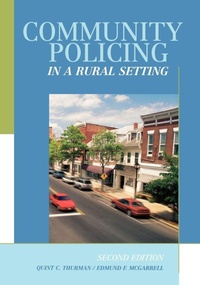
Community Policing in a Rural Setting
2nd Edition
Published on 1. June 2005
Book
Paperback/Softback
196 pages
978-1-58360-534-9 (ISBN)
Description
The authors provide stepping stones for rural and small-town agencies to make the organizational changes needed for community policing to take hold. The book introduces the concept of community policing and its many benefits to the agencies and communities that adopt it. Important issues discussed include the challenge of organizational change, as well as examples of community policing obstacles and successes, and the future of community policing in the 21st century.
More details
Edition
2nd edition
Language
English
Place of publication
Cincinnati
United States
Publishing group
Taylor & Francis Inc
Dimensions
Height: 254 mm
Width: 178 mm
Thickness: 11 mm
Weight
384 gr
ISBN-13
978-1-58360-534-9 (9781583605349)
Copyright in bibliographic data and cover images is held by Nielsen Book Services Limited or by the publishers or by their respective licensors: all rights reserved.
Schweitzer Classification
Other editions
Additional editions
Quint Thurman | Edmund F. McGarrell
Community Policing in a Rural Setting
E-Book
10/2014
2nd Edition
Routledge
€51.49
Available for download
Quint Thurman | Edmund F. McGarrell
Community Policing in a Rural Setting
E-Book
10/2014
2nd Edition
Routledge
€51.49
Available for download
Persons
Content
Section I: The Challenges of Community Policing in Rural and Small-Town America 1. Community Policing in a Rural Setting: An Introduction 2. Operationalizing Community Policing in Rural America: Sense and Nonsense 3. The State of Community Policing in Small Towns and Rural Areas 4. Facilitators and Obstacles to Community Policing in Rural America Section II: Organizational Change and Community Policing 5. Assessing the Need for Organizational Change in Rural American Police Agencies 6. The Work Routines and Citizen Interactions of Small-Town and Rural Police Officers 7. Celebrating Agency Culture: Engaging a Traditional Cop's Heart in Organizational Change 8. Getting to Know Your Employees Better 9. Linking the Right Person to the Right Job: Selecting, Training, and Retaining Officers to Do Community Policing Section III: The Community Role in Community Policing 10. The Police and Community Organizing 11. The Benefits of Community Policing in Rural Oklahoma 12. Getting to Know Your Community Through Citizen Surveys and Focus Group Interviews 13. Problem-Solving Auto Theft in Unincorporated Hillsborough County, Florida 14. Innovative Community Crime Prevention: An Overview of the Mountlake Terrace Neutral Zone-AmeriCorps Program Section IV: Rural Community Policing and the Future 15. Future Challenges: The Urbanization of Rural America Appendix A: Police Department Employee Survey Instrument Appendix B: Police Department Employee Focus Group Questionnaire Appendix C: Community Survey Instrument Appendix D: Community Focus Group Questionnaire