

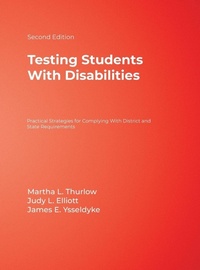
Testing Students With Disabilities
Practical Strategies for Complying With District and State Requirements
2nd Edition
Published on 13. February 2003
Book
Hardback
344 pages
978-0-7619-3808-8 (ISBN)
Description
Updated Edition of Best Seller!
"Testing Students With Disabilities is firmly grounded in the cutting edge research the authors have conducted for nearly three decades. They have done a brilliant job of treating a very complex topic in a most readable, logical, and understandable way."
Donald Deshler, Professor of Special Education
University of Kansas
"Testing Students With Disabilities is a 'must buy' for individuals involved in the education of students with disabilities, whether they are currently acting as or studying to be service providers. My hat is off to the authors for breaking down this critical information in a way that is understandable and easy to share."
Sue Gamm, Chief Specialized Services Officer
Chicago Public Schools
"This is a seminal work on the 'how to' of testing, assessment, and accountability for students with disabilities. Not only do the authors help bring this most important topic into clarity, but they also share practical ways to implement their suggestions immediately by providing the tools to get started."
Alice D. Parker, Assistant Superintendent of Public Instruction
California Department of Education
The definitive resource on everything you need to know and do about assessing special needs students-now expanded and improved!
An increased focus on educational accountability and testing, coupled with mandates put forth in the Elementary and Secondary Education Act (ESEA) and the Individuals with Disabilities Education Act (IDEA), make it crucial that every district and school professional is well versed in meeting the assessment requirements for all students.
The enhanced second edition of Testing Students With Disabilities covers everything from maximizing the Individualized Education Program (IEP) and fostering successful collaboration among educators, administrators, and parents to optimizing assessment accommodations and using test scores to improve instruction.
Other new and expanded topics include:
Requirements of IDEA and ESEA
Students with disabilities who are English Language Learners
Electronic and online testing
Alternate assessments
Use of assessment results
Access to the general curriculum
The timely update of this popular guide offers the specific tactics, concrete examples, and user-friendly information necessary to effectively and meaningfully include students with disabilities in district and state assessment systems. It features an array of indispensable tools, such as reproducible forms, checklists, handouts, and overheads; a comprehensive list of national and regional technical assistance and dissemination networks; and techniques for conducting staff development.
"Testing Students With Disabilities is firmly grounded in the cutting edge research the authors have conducted for nearly three decades. They have done a brilliant job of treating a very complex topic in a most readable, logical, and understandable way."
Donald Deshler, Professor of Special Education
University of Kansas
"Testing Students With Disabilities is a 'must buy' for individuals involved in the education of students with disabilities, whether they are currently acting as or studying to be service providers. My hat is off to the authors for breaking down this critical information in a way that is understandable and easy to share."
Sue Gamm, Chief Specialized Services Officer
Chicago Public Schools
"This is a seminal work on the 'how to' of testing, assessment, and accountability for students with disabilities. Not only do the authors help bring this most important topic into clarity, but they also share practical ways to implement their suggestions immediately by providing the tools to get started."
Alice D. Parker, Assistant Superintendent of Public Instruction
California Department of Education
The definitive resource on everything you need to know and do about assessing special needs students-now expanded and improved!
An increased focus on educational accountability and testing, coupled with mandates put forth in the Elementary and Secondary Education Act (ESEA) and the Individuals with Disabilities Education Act (IDEA), make it crucial that every district and school professional is well versed in meeting the assessment requirements for all students.
The enhanced second edition of Testing Students With Disabilities covers everything from maximizing the Individualized Education Program (IEP) and fostering successful collaboration among educators, administrators, and parents to optimizing assessment accommodations and using test scores to improve instruction.
Other new and expanded topics include:
Requirements of IDEA and ESEA
Students with disabilities who are English Language Learners
Electronic and online testing
Alternate assessments
Use of assessment results
Access to the general curriculum
The timely update of this popular guide offers the specific tactics, concrete examples, and user-friendly information necessary to effectively and meaningfully include students with disabilities in district and state assessment systems. It features an array of indispensable tools, such as reproducible forms, checklists, handouts, and overheads; a comprehensive list of national and regional technical assistance and dissemination networks; and techniques for conducting staff development.
Reviews / Votes
"Testing Students With Disabilities is firmly grounded in the cutting edge research the authors have conducted for nearly three decades. They have done a brilliant job of treating a very complex topic in a most readable, logical, and understandable way." -- Donald Deshler, Professor of Special Education "Testing Students With Disabilities is a 'must buy' for individuals involved in the education of students with disabilities, whether they are currently acting as or studying to be service providers. My hat is off to the authors for breaking down this critical information in a way that is understandable and easy to share." -- Sue Gamm, Chief Specialized Services Officer "This book is a valuable tool for practitioners who want immediate understanding and hands-on application of testing students with disabilities. The authors give specific examples that school district personnel can adapt to meet their school's context and needs." -- Denise Meister, Assistant Professor of Education "I enjoyed reading the material! The newly revised edition shows that the authors desired to keep the material up-to-date and to impress upon the readers the importance of the laws, but more importantly, the spirit in which the laws were enacted." -- Elizabeth M. Were, Professor "This is a seminal work on the 'how to' of testing, assessment, and accountability for students with disabilities. Not only do the authors help bring this most important topic into clarity, but they also share practical ways to implement their suggestions immediately by providing the tools to get started." -- Alice D. Parker, Assistant Superintendent of Public InstructionMore details
Edition
2nd Revised edition
Language
English
Place of publication
Thousand Oaks
United States
Target group
Professional and scholarly
Edition type
Revised edition
Product notice
Cloth over boards
Dimensions
Height: 286 mm
Width: 221 mm
Thickness: 23 mm
Weight
1126 gr
ISBN-13
978-0-7619-3808-8 (9780761938088)
Copyright in bibliographic data and cover images is held by Nielsen Book Services Limited or by the publishers or by their respective licensors: all rights reserved.
Schweitzer Classification
Other editions
Additional editions
Martha L. Thurlow | Judy L. Elliott | James E. Ysseldyke
Testing Students With Disabilities
Practical Strategies for Complying With District and State Requirements
Book
01/2003
2nd Edition
SAGE Publications Inc
€48.90
Shipment within 15-20 days
Previous edition
Martha L. Thurlow | Judy L. Elliott | James E. Ysseldyke
Testing Students With Disabilities
Practical Strategies for Complying With District and State Requirements
Book
12/1997
1st Edition
Corwin Press Inc
€91.80
Article exhausted; check for reprint
Persons
Martha L. Thurlow, Ph.D., is Director of the National Center on Educational Outcomes in the Institute on Community Integration (University Center for Excellence in Developmental Disabilities) at the University of Minnesota. In this position, she addresses the implications of contemporary U.S. policy and practice for students with disabilities and English Language Learners, including national and statewide assessment policies and practices, standards-setting efforts, and graduation requirements. Dr. Thurlow has conducted research for the past 35 years in a variety of areas, including assessment and decision making, learning disabilities, early childhood education, dropout prevention, effective classroom instruction, and integration of students with disabilities in general education settings. She has published extensively on all of these topics, and also recently completed serving as co-Editor with Bob Algozzine of Exceptional Children, the research journal of the Council for Exceptional Children. Dr. Thurlow is a co-author of several books, including Testing Students with Disabilities, Improving Test Performance of Students with Disabilities, Alternate Assessments for Students with Disabilities, and Critical Issues in Special Education. Dr. Thurlow was one of the original developers of the dropout prevention program Check and Connect, which was empirically tested, and replicated in several settings. She is the author of numerous reports, journal articles and chapters on the topic of dropouts and dropout prevention, and also addresses the dropout problem within the current context of federal legislation, high stakes testing, and standards-based education.
Jim Ysseldyke, Ph.D., is Birkmaier Professor in the Department of Educational Psychology, director of the School Psychology Program, and director of the Center for Reading Research at the University of Minnesota. Widely requested as a staff developer and conference speaker, Ysseldyke brings more than 30 years of research and teaching experience to educational professionals around the globe.
As the former director of the federally funded National Center on Educational Outcomes, Ysseldyke conducted research and provided technical support that helped to boost the academic performance of students with disabilities and improve school assessment techniques nationally. Today, he continues to work to improve the education of students with disabilities.
The author of more than 300 publications on special education and school psychology, Ysseldyke is best known for his textbooks on assessment, effective instruction, issues in special education, and other cutting-edge areas of education and school psychology. With A Practical Approach to Special Education for Every Teacher, Ysseldyke seeks to equip educators with practical knowledge and methods that will help them to better engage students in exploring-and meeting-all their potentials.
Jim Ysseldyke, Ph.D., is Birkmaier Professor in the Department of Educational Psychology, director of the School Psychology Program, and director of the Center for Reading Research at the University of Minnesota. Widely requested as a staff developer and conference speaker, Ysseldyke brings more than 30 years of research and teaching experience to educational professionals around the globe.
As the former director of the federally funded National Center on Educational Outcomes, Ysseldyke conducted research and provided technical support that helped to boost the academic performance of students with disabilities and improve school assessment techniques nationally. Today, he continues to work to improve the education of students with disabilities.
The author of more than 300 publications on special education and school psychology, Ysseldyke is best known for his textbooks on assessment, effective instruction, issues in special education, and other cutting-edge areas of education and school psychology. With A Practical Approach to Special Education for Every Teacher, Ysseldyke seeks to equip educators with practical knowledge and methods that will help them to better engage students in exploring-and meeting-all their potentials.
Content
Preface
About the Authors
1. Why Students With Disabilities Should Be in District and Statewide Accountability Systems
2. Deciding How Students Participate in District and State Tests
3. Assessment Accommodations: Who Is Eligible? For What?
4. Accommodations to Consider
5. Alternate Assessments
6. Including English Language Learners With Disabilities in District and State Assessments
7. Using Assessment Results
8. An Important Tool: The IEP
9. Collaboration for Success in Testing Students With Disabilities
10. Gaining Support From Above: What Needs to Happen
11. Involving Parents in Testing Decisions
12. Implementation: The Good, The Bad, and The Ugly
Resources: Reproducible Forms
Resources: Staff Development
Resources: Technical Assistance and Dissemination Networks
Index
About the Authors
1. Why Students With Disabilities Should Be in District and Statewide Accountability Systems
2. Deciding How Students Participate in District and State Tests
3. Assessment Accommodations: Who Is Eligible? For What?
4. Accommodations to Consider
5. Alternate Assessments
6. Including English Language Learners With Disabilities in District and State Assessments
7. Using Assessment Results
8. An Important Tool: The IEP
9. Collaboration for Success in Testing Students With Disabilities
10. Gaining Support From Above: What Needs to Happen
11. Involving Parents in Testing Decisions
12. Implementation: The Good, The Bad, and The Ugly
Resources: Reproducible Forms
Resources: Staff Development
Resources: Technical Assistance and Dissemination Networks
Index