

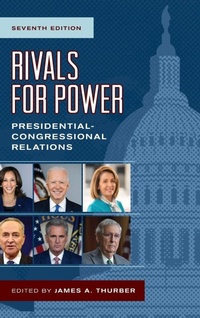
Rivals for Power
Presidential-Congressional Relations
7th Edition
Published on 15. July 2022
Book
Hardback
366 pages
978-1-5381-0077-6 (ISBN)
Description
Now in its seventh edition, Rivals for Power: Presidential-Congressional Relations brings together the knowledge of leading scholars and scholar-practitioners alike to explain the complex political dynamic between the president and Congress. Contributors analyze the structural, political, and behavioral factors that shape this relationship, while showing how and why rivalry has tended to intensify when different parties control the two branches.
Intended for students, scholars, public officials, and the general public, Rivals for Power offers an accessible and engaging analysis of executive and legislative rivalry across a span of eras, with particular attention to developments from the Obama, Trump, and Biden presidencies.
Intended for students, scholars, public officials, and the general public, Rivals for Power offers an accessible and engaging analysis of executive and legislative rivalry across a span of eras, with particular attention to developments from the Obama, Trump, and Biden presidencies.
Reviews / Votes
Thurber and Tama present an excellent edited volume studying seemingly every facet of the relationship between Congress and the president. The authors outline the complex political dynamics, intense constitutional rivalry, and evolving electoral and policy demands that define this relationship. This well-written book-clearly intended for a general audience-should be commended for its comprehensive nature and its impressive list of contributors.... [A] valuable contribution to the scholarly literature about Congress, the presidency, and American politics. Highly recommended. All readership levels. * Choice Reviews * Nobody better understands the unique power dynamics of the American political system than Jim Thurber. The competition and cooperation, the distortions of partisanship, the (sometimes ignored) constitutional constraints, all come under the Thurber microscope in this absolutely invaluable study. Shaped by Professor Thurber's guiding hand, Rivals for Power is a marvelous compilation of work by some of America's top political scholars, combining to give us all a better understanding of the complex machinations of American government. -- Former Congressman Mickey Edwards, lecturer and visiting professor, Princeton University For the 7th edition, James Thurber has done it again: he has enlisted top scholars to write perceptive essays about congressional-presidential relations. This concise volume addresses enduring questions and contemporary issues in a way that will appeal to college students and practitioners alike. It will be a valuable addition to courses on Congress, the presidency, and American politics in general. -- John J. Pitney Jr., Roy P. Crocker Professor of American Politics, Claremont McKenna CollegeMore details
Edition
7th edition
Language
English
Place of publication
United States
Publishing group
Bloomsbury Publishing Plc
Target group
College/higher education
US School Grade: From College Freshman to College Graduate Student, Interest Age: From 18 to 22 years
Illustrations
8 b/w illustrations;8 tables
Dimensions
Height: 235 mm
Width: 157 mm
Thickness: 26 mm
Weight
744 gr
ISBN-13
978-1-5381-0077-6 (9781538100776)
Copyright in bibliographic data and cover images is held by Nielsen Book Services Limited or by the publishers or by their respective licensors: all rights reserved.
Schweitzer Classification
Other editions
Additional editions
E-Book
07/2022
7th Edition
Rowman & Littlefield Publishers
€38.49
Available for download
Person
James A. Thurber is University Distinguished Professor of Government and Founder (1979) and Former Director (1979-2016) of the Center for Congressional and Presidential Studies at American University in Washington, D.C.
Content
List of Figures and Tables
Preface
Chapter 1: An Introduction to Presidential-Congressional Rivalry James Thurber
Chapter 2: Voters, Elections and the President's Agenda in Congress: Joe Biden's First Year Gary C. Jacobson
Chapter 3: How Donald Trump Tried to Overthrow the 2020 ElectionJames Pfiffner
Chapter 4: Assessing Presidential and Congressional Rivalry in an Era of Polarization Sarah Binder
Chapter 5: Unilateral Presidential Authority: Uses and AbusesJames Pfiffner
Chapter 6: Biden on the Tight Rope: Managing Congressional Relations in a Polarized Era Gary Andres and Pat Griffin
Chapter 7: A Centrist President Faces a Polarized CongressRoss Baker
Chapter 8: Rivalry for Power in the Judicial Appointment Process John Anthony Maltese
Chapter 9: The President, Congress, and Foreign Policy Edward Alden
Chapter 10: Biden's Choice on Foreign Policy: A New Internationalism or America First? Leon E. Panetta
Chapter 11: Presidents, Congress and Budget Decisions: Risks, Responsibilities, and OpportunitiesJoseph White
Chapter 12: The President, Congress and the Politics of Regulation Claudia Thurber
Chapter 13: The President, Congress and the Media Ron Elving
Chapter 14: The Investigative Check in a Polarized Era: Still Empowered or Imperiled? Douglas Kriner
Chapter 15: Closing the Deal? Presidential Leadership and Legislative Negotiation
David C. Barker and Matthew N. Green
Index
About the Contributors
Preface
Chapter 1: An Introduction to Presidential-Congressional Rivalry James Thurber
Chapter 2: Voters, Elections and the President's Agenda in Congress: Joe Biden's First Year Gary C. Jacobson
Chapter 3: How Donald Trump Tried to Overthrow the 2020 ElectionJames Pfiffner
Chapter 4: Assessing Presidential and Congressional Rivalry in an Era of Polarization Sarah Binder
Chapter 5: Unilateral Presidential Authority: Uses and AbusesJames Pfiffner
Chapter 6: Biden on the Tight Rope: Managing Congressional Relations in a Polarized Era Gary Andres and Pat Griffin
Chapter 7: A Centrist President Faces a Polarized CongressRoss Baker
Chapter 8: Rivalry for Power in the Judicial Appointment Process John Anthony Maltese
Chapter 9: The President, Congress, and Foreign Policy Edward Alden
Chapter 10: Biden's Choice on Foreign Policy: A New Internationalism or America First? Leon E. Panetta
Chapter 11: Presidents, Congress and Budget Decisions: Risks, Responsibilities, and OpportunitiesJoseph White
Chapter 12: The President, Congress and the Politics of Regulation Claudia Thurber
Chapter 13: The President, Congress and the Media Ron Elving
Chapter 14: The Investigative Check in a Polarized Era: Still Empowered or Imperiled? Douglas Kriner
Chapter 15: Closing the Deal? Presidential Leadership and Legislative Negotiation
David C. Barker and Matthew N. Green
Index
About the Contributors