

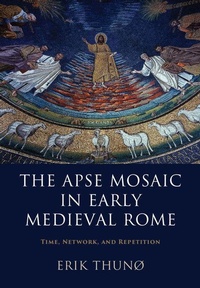
The Apse Mosaic in Early Medieval Rome
Time, Network, and Repetition
Published on 20. April 2015
Book
Hardback
358 pages
978-1-107-06990-9 (ISBN)
Description
This book focuses on apse mosaics in Rome, which were commissioned by a series of popes between the sixth and ninth centuries CE. Through a synchronic approach that challenges current conceptions about how works of art interact with historical time, Erik Thuno proposes that the apse mosaics produce an inter-visual network that collapses their chronological succession in time into a continuous present in which the faithful join the saints in the one living body of the Church of Rome. Throughout, this book situates the apse mosaics within the broader context of viewership, the cult of relics, epigraphic tradition, and church ritual while engaging topics concerned with intercession, materiality, repetition and vision.
More details
Language
English
Place of publication
Cambridge
United Kingdom
Target group
Professional and scholarly
Illustrations
25 Plates, color; 78 Halftones, unspecified; 26 Line drawings, unspecified
Dimensions
Height: 260 mm
Width: 183 mm
Thickness: 24 mm
Weight
872 gr
ISBN-13
978-1-107-06990-9 (9781107069909)
Copyright in bibliographic data and cover images is held by Nielsen Book Services Limited or by the publishers or by their respective licensors: all rights reserved.
Schweitzer Classification
Other editions
Additional editions
E-Book
04/2015
Cambridge University Press
€84.99
Available for download
E-Book
03/2015
Cambridge University Press
€100.99
Available for download
Person
Erik Thuno is Associate Professor of Medieval Art at Rutgers University. He is the author of numerous articles on medieval art and his book Image and Relic: Mediating the Sacred in Early Medieval Rome was published in 2002. He has been awarded fellowships by the Clark Art Institute, the Alexander von Humboldt Foundation, and the Bibliotheca Hertziana (Max Planck Institute for Art History) in Rome.
Content
1. Repetition: saints, popes, and golden texts; 2. Transformation: from material church to spiritual body; 3. Incorporation: becoming a living stone; 4. Networking: building a communion sanctorum; Afterword: meaning and presence; Appendix.