

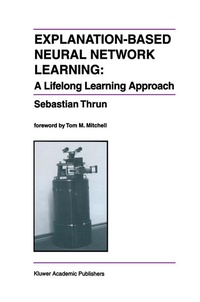
Explanation-Based Neural Network Learning
A Lifelong Learning Approach
Published on 17. October 2011
Book
Paperback/Softback
XVI, 264 pages
978-1-4612-8597-7 (ISBN)
Description
Lifelong learning addresses situations in which a learner faces a series of different learning tasks providing the opportunity for synergy among them. Explanation-based neural network learning (EBNN) is a machine learning algorithm that transfers knowledge across multiple learning tasks. When faced with a new learning task, EBNN exploits domain knowledge accumulated in previous learning tasks to guide generalization in the new one. As a result, EBNN generalizes more accurately from less data than comparable methods.
Explanation-Based Neural Network Learning: A Lifelong Learning
Approach
describes the basic EBNN paradigm and investigates it in the context of supervised learning, reinforcement learning, robotics, and chess.
` The paradigm of lifelong learning - using earlier learned knowledge to improve subsequent learning - is a promising direction for a new generation of machine learning algorithms. Given the need for more accurate learning methods, it is difficult to imagine a future for machine learning that does not include this paradigm. '
From the Foreword by Tom M. Mitchell.
` The paradigm of lifelong learning - using earlier learned knowledge to improve subsequent learning - is a promising direction for a new generation of machine learning algorithms. Given the need for more accurate learning methods, it is difficult to imagine a future for machine learning that does not include this paradigm. '
From the Foreword by Tom M. Mitchell.
More details
Series
Edition
Softcover reprint of the original 1st ed. 1996
Language
English
Place of publication
New York
United States
Target group
Professional and scholarly
Research
Illustrations
XVI, 264 p.
Dimensions
Height: 235 mm
Width: 155 mm
Thickness: 16 mm
Weight
435 gr
ISBN-13
978-1-4612-8597-7 (9781461285977)
DOI
10.1007/978-1-4613-1381-6
Schweitzer Classification
Other editions
Additional editions
Book
04/1996
Kluwer Academic Publishers
€160.49
Shipment within 15-20 days
Content
1 Introduction.- 1.1 Motivation.- 1.2 Lifelong Learning.- 1.3 A Simple Complexity Consideration.- 1.4 The EBNN Approach to Lifelong Learning.- 1.5 Overview.- 2 Explanation-Based Neural Network Learning.- 2.1 Inductive Neural Network Learning.- 2.2 Analytical Learning.- 2.3 Why Integrate Induction and Analysis?.- 2.4 The EBNN Learning Algorithm.- 2.5 A Simple Example.- 2.6 The Relation of Neural and Symbolic Explanation-Based Learning.- 2.7 Other Approaches that Combine Induction and Analysis.- 2.8 EBNN and Lifelong Learning.- 3 The Invariance Approach.- 3.1 Introduction.- 3.2 Lifelong Supervised Learning.- 3.3 The Invariance Approach.- 3.4 Example: Learning to Recognize Objects.- 3.5 Alternative Methods.- 3.6 Remarks.- 4 Reinforcement Learning.- 4.1 Learning Control.- 4.2 Lifelong Control Learning.- 4.3 Q-Learning.- 4.4 Generalizing Function Approximators and Q-Learning.- 4.5 Remarks.- 5 Empirical Results.- 5.1 Learning Robot Control.- 5.2 Navigation.- 5.3 Simulation.- 5.4 Approaching and Grasping a Cup.- 5.5 NeuroChess.- 5.6 Remarks.- 6 Discussion.- 6.1 Summary.- 6.2 Open Problems.- 6.3 Related Work.- 6.4 Concluding Remarks.- A An Algorithm for Approximating Values and Slopes with Artificial Neural Networks.- A.1 Definitions.- A.2 Network Forward Propagation.- A.3 Forward Propagation of Auxiliary Gradients.- A.4 Error Functions.- A.5 Minimizing the Value Error.- A.6 Minimizing the Slope Error.- A.7 The Squashing Function and its Derivatives.- A.8 Updating the Network Weights and Biases.- B Proofs of the Theorems.- C Example Chess Games.- C.1 Game 1.- C.2 Game 2.- References.- List of Symbols.