

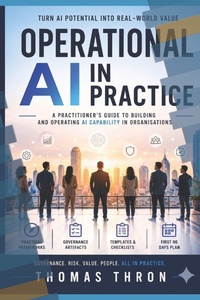
OPERATIONAL AI IN PRACTICE
A Practitioner's Guide to Building and Operating AI Capability in Organisations
Published on 1. June 2026
Book
Paperback/Softback
242 pages
979-8-1995-2005-8 (ISBN)
Description
OPERATIONAL AI IN PRACTICE
>Most organisations today are stuck between AI pilots and AI capability. This book is the field guide for closing that gap. Projects stall. Pilots never scale. Governance arrives too late. Benefits are overstated. Ownership is unclear. Leaders are left asking the same question: "How do we actually make AI work in practice?" There is no shortage of writing on AI strategy, AI ethics or AI engineering. There is far less on the operating discipline that sits between them - the work required to turn a collection of promising experiments into a capability that delivers value year after year. Operational AI in Practice is a practical handbook for Heads of AI, CIOs, COOs, transformation leaders, governance professionals, programme sponsors and delivery teams responsible for making AI work inside real organisations. This is a working handbook, not a manifesto. You are not short of ambition. You are short of an operating model. Inside you'll learn how to: - Build an AI capability rather than a collection of disconnected projects
- Identify and prioritise high-value AI opportunities
- Establish proportionate governance without stifling innovation
- Navigate organisational politics and stakeholder resistance
- Decide when to build, buy, partner, or use embedded AI solutions
- Create practical operating models for AI deployment and oversight
- Manage risk, compliance, accountability and assurance activities
- Monitor AI systems after deployment and realise measurable business value
>Designed to be used on Monday morning Alongside the framework, you'll gain access to practical tools you can apply immediately, including: - A pragmatic baseline of the ten foundational practices that capture most of the risk for most organisations
- A five-level maturity ladder for assessing your current state and planning your next step
- A first 90 days plan for newly appointed AI leaders
- Twenty ready-to-use governance artefacts, templates, decision aids and implementation tools
- AI inventories, intake forms, scoring matrices, business-case templates, risk assessments, model cards, go-live checklists, monitoring plans and benefits-realisation reviews
- Stakeholder engagement packs, communication templates and leadership briefing materials
>Why this book is different Most AI books either inspire without telling you what to do or dive so deeply into technical detail that they become difficult to apply. Drawing on real-world experience across operational excellence, transformation, governance and AI delivery, this guide focuses on what organisations actually need to do not what they wish were true. Whether you are establishing an AI function, governing an existing AI estate, leading a transformation programme, or sponsoring AI initiatives at executive level, this book provides a practical roadmap for moving from experimentation to sustainable capability. Because successful AI is not just about the model. It's about the organisation around it.
>Most organisations today are stuck between AI pilots and AI capability. This book is the field guide for closing that gap. Projects stall. Pilots never scale. Governance arrives too late. Benefits are overstated. Ownership is unclear. Leaders are left asking the same question: "How do we actually make AI work in practice?" There is no shortage of writing on AI strategy, AI ethics or AI engineering. There is far less on the operating discipline that sits between them - the work required to turn a collection of promising experiments into a capability that delivers value year after year. Operational AI in Practice is a practical handbook for Heads of AI, CIOs, COOs, transformation leaders, governance professionals, programme sponsors and delivery teams responsible for making AI work inside real organisations. This is a working handbook, not a manifesto. You are not short of ambition. You are short of an operating model. Inside you'll learn how to: - Build an AI capability rather than a collection of disconnected projects
- Identify and prioritise high-value AI opportunities
- Establish proportionate governance without stifling innovation
- Navigate organisational politics and stakeholder resistance
- Decide when to build, buy, partner, or use embedded AI solutions
- Create practical operating models for AI deployment and oversight
- Manage risk, compliance, accountability and assurance activities
- Monitor AI systems after deployment and realise measurable business value
>Designed to be used on Monday morning Alongside the framework, you'll gain access to practical tools you can apply immediately, including: - A pragmatic baseline of the ten foundational practices that capture most of the risk for most organisations
- A five-level maturity ladder for assessing your current state and planning your next step
- A first 90 days plan for newly appointed AI leaders
- Twenty ready-to-use governance artefacts, templates, decision aids and implementation tools
- AI inventories, intake forms, scoring matrices, business-case templates, risk assessments, model cards, go-live checklists, monitoring plans and benefits-realisation reviews
- Stakeholder engagement packs, communication templates and leadership briefing materials
>Why this book is different Most AI books either inspire without telling you what to do or dive so deeply into technical detail that they become difficult to apply. Drawing on real-world experience across operational excellence, transformation, governance and AI delivery, this guide focuses on what organisations actually need to do not what they wish were true. Whether you are establishing an AI function, governing an existing AI estate, leading a transformation programme, or sponsoring AI initiatives at executive level, this book provides a practical roadmap for moving from experimentation to sustainable capability. Because successful AI is not just about the model. It's about the organisation around it.