

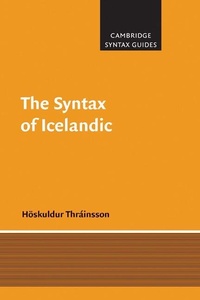
The Syntax of Icelandic
Published on 3. February 2011
Book
Paperback/Softback
576 pages
978-0-521-59790-6 (ISBN)
Description
Icelandic is a syntactically interesting language, with aspects of its word order, clause structure, agreement patterns and case system arousing much theoretical interest and debate in recent years. This is an informative and accessible guide to the structure of Icelandic, focusing in particular on those characteristics that have contributed greatly to syntactic research. Each chapter is divided into two main sections - providing both a descriptive overview and a discussion of the theoretical and comparative issues involved - and a wide range of topics are covered, including case, agreement, grammatical relations, thematic roles, word order, clause structure, fronting, extraposition, complement, adjuncts, pronouns, and inflection. Also explored in detail are the similarities and differences between Icelandic and other related languages. Presupposing only a basic knowledge of syntax and complete with an extensive bibliography, this comprehensive survey will be an important tool for all those working on the structure of Scandinavian and Germanic languages.
More details
Series
Language
English
Place of publication
Cambridge
United Kingdom
Target group
College/higher education
Professional and scholarly
Product notice
Paperback (trade)
Illustrations
Worked examples or Exercises
Dimensions
Height: 229 mm
Width: 152 mm
Thickness: 34 mm
Weight
923 gr
ISBN-13
978-0-521-59790-6 (9780521597906)
Copyright in bibliographic data and cover images is held by Nielsen Book Services Limited or by the publishers or by their respective licensors: all rights reserved.
Schweitzer Classification
Other editions
Additional editions
Hoeskuldur Thrainsson
The Syntax of Icelandic
Book
10/2007
Cambridge University Press
€146.50
Shipment within 15-20 days
Person
Content
1. Introduction; 2. Word order and clause structure; 3. Order of elements within the phrases; 4. Case, agreement, grammatical relations and thematic roles; 5. Passives, middles and unaccusatives; 6. Expletive constructions and clause structure; 7. Fronting, focussing, extraposition and NP-shift; 8. Finite and non-finite complements and adjuncts; 9. Pronouns, reflexives and empty categories.