

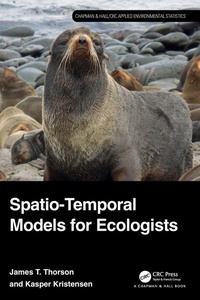
Spatio-Temporal Models for Ecologists
1st Edition
Published on 27. February 2024
Book
Hardback
276 pages
978-1-032-53101-4 (ISBN)
Description
Ecological dynamics are tremendously complicated and are studied at a variety of spatial and temporal scales. Ecologists often simplify analysis by describing changes in density of individuals across a landscape, and statistical methods are advancing rapidly for studying spatio-temporal dynamics. However, spatio-temporal statistics is often presented using a set of principles that may seem very distant from ecological theory or practice. This book seeks to introduce a minimal set of principles and numerical techniques for spatio-temporal statistics that can be used to implement a wide range of real-world ecological analyses regarding animal movement, population dynamics, community composition, causal attribution, and spatial dynamics. We provide a step-by-step illustration of techniques that combine core spatial-analysis packages in R with low-level computation using Template Model Builder. Techniques are showcased using real-world data from varied ecological systems, providing a toolset for hierarchical modelling of spatio-temporal processes. Spatio-Temporal Models for Ecologists is meant for graduate level students, alongside applied and academic ecologists.
Key Features:
Foundational ecological principles and analyses
Thoughtful and thorough ecological examples
Analyses conducted using a minimal toolbox and fast computation
Code using R and TMB included in the book and available online
Key Features:
Foundational ecological principles and analyses
Thoughtful and thorough ecological examples
Analyses conducted using a minimal toolbox and fast computation
Code using R and TMB included in the book and available online
More details
Series
Language
English
Place of publication
United Kingdom
Publishing group
Taylor & Francis Ltd
Target group
Professional and scholarly
Academic
Illustrations
82 farbige Abbildungen, 16 s/w Zeichnungen, 82 farbige Zeichnungen, 19 s/w Tabellen, 2 farbige Tabellen, 16 s/w Abbildungen
2 Tables, color; 19 Tables, black and white; 82 Line drawings, color; 16 Line drawings, black and white; 82 Illustrations, color; 16 Illustrations, black and white
Dimensions
Height: 260 mm
Width: 183 mm
Thickness: 20 mm
Weight
752 gr
ISBN-13
978-1-032-53101-4 (9781032531014)
Copyright in bibliographic data and cover images is held by Nielsen Book Services Limited or by the publishers or by their respective licensors: all rights reserved.
Schweitzer Classification
Other editions
Additional editions
James Thorson | Kasper Kristensen
Spatio-Temporal Models for Ecologists
E-Book
02/2024
1st Edition
Taylor & Francis
€115.99
Available for download
James Thorson | Kasper Kristensen
Spatio-Temporal Models for Ecologists
E-Book
02/2024
1st Edition
Taylor & Francis
€115.99
Available for download
Persons
James Thorson is a statistical ecologist at the Alaska Fisheries Science Center within the National Marine Fisheries Service. His research interests include population dynamics, life-history theory, and methods for the sustainable management of natural resources. He has taught graduate-level courses in hierarchical modelling and spatio-temporal statistics at University of Washington.
Kasper Kristensen is a Senior Researcher at Danish Technical University. His research interests include spatio-temporal statistics and computational methods. He developed the R-package TMB, which is seeing increased use throughout ecology. For example, TMB is the computational backend for R-package glmmTMB, which has been cited over 3000 times from 2017-2022.
Kasper Kristensen is a Senior Researcher at Danish Technical University. His research interests include spatio-temporal statistics and computational methods. He developed the R-package TMB, which is seeing increased use throughout ecology. For example, TMB is the computational backend for R-package glmmTMB, which has been cited over 3000 times from 2017-2022.
Content
Part 1: Introductory 1. Statistical models for individual-based processes 2. Hierarchical models and Laplace approximation Part 2: Basic 3. Population dynamics and state-space models 4. Individual movement 5. Spatial models 6. Spatial sampling designs and analysis 7. Covariates affecting densities and detectability Part 3: Advanced 8. Spatio-temporal models with seasonal or multi-year dynamics 9. Ecological teleconnections 10. Population movement and habitat selection 11. Multispecies models for community diversity and biogeography 12. A decadal forecast for spatio-temporal models A. Acknowledgements B. Appendices