

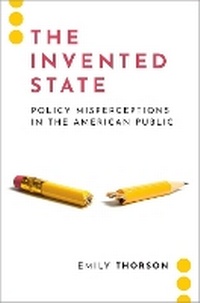
The Invented State
Policy Misperceptions in the American Public
Published on 2. January 2024
Book
Hardback
178 pages
978-0-19-751232-6 (ISBN)
Description
In The Invented State, Emily Thorson argues that a problematic and understudied aspect of political misinformation reflects widespread public misperception about what the government does. Because much of public policy is invisible to the public, there is fertile ground for false beliefs to flourish, leading to the creation of what Thorson terms the "invented state": systematic misperceptions about public policy. However, people get the facts wrong not because they are lazy, stupid, or blinded by partisan loyalty. Rather, misperceptions are created when three conditions are met: when citizens have incomplete information about an issue, when their own biases color their understanding of it, and when they feel that the issue is important. In other words, the invented state is created not just by exposure to explicit misinformation, but also by individuals' cognitive errors.
Correcting these policy misperceptions is highly effective at reducing false beliefs. In addition, providing people with corrective information has downstream effects on attitudes. When they learn how policies - including Social Security, refugee policy, and the Temporary Assistance for Needy Families program - really work, their approval of these policies increases, and they also shift their policy priorities. Contrary to pundits' assumptions of a public who is largely indifferent to policy, there is a deep public desire to learn basic facts about how the government works. Thorson meets that desire with analysis on how the news media can identify and effectively correct substantive policy misperceptions. The Invented State not only sheds a new light on how Americans think about policy, but can also help to inform evidence-based interventions to improve democratic competence.
Correcting these policy misperceptions is highly effective at reducing false beliefs. In addition, providing people with corrective information has downstream effects on attitudes. When they learn how policies - including Social Security, refugee policy, and the Temporary Assistance for Needy Families program - really work, their approval of these policies increases, and they also shift their policy priorities. Contrary to pundits' assumptions of a public who is largely indifferent to policy, there is a deep public desire to learn basic facts about how the government works. Thorson meets that desire with analysis on how the news media can identify and effectively correct substantive policy misperceptions. The Invented State not only sheds a new light on how Americans think about policy, but can also help to inform evidence-based interventions to improve democratic competence.
Reviews / Votes
This book is a must read for scholars of media studies, public policy, and public opinion. Highly recommended. Highly recommended. * Choice *More details
Series
Language
English
Place of publication
New York
United States
Target group
Professional and scholarly
Dimensions
Height: 156 mm
Width: 235 mm
Thickness: 15 mm
Weight
390 gr
ISBN-13
978-0-19-751232-6 (9780197512326)
Copyright in bibliographic data and cover images is held by Nielsen Book Services Limited or by the publishers or by their respective licensors: all rights reserved.
Schweitzer Classification
Other editions
Additional editions
Book
06/2024
Oxford University Press Inc
€25.00
Shipment within 15-20 days
E-Book
12/2023
OUP eBook
€18.49
Available for download
E-Book
12/2023
OUP eBook
€18.49
Available for download
Person
Emily Thorson is an Assistant Professor of Political Science at Syracuse University. Her research focuses on how people learn about the political world. She is particularly interested in understanding what people get wrong about politics and policy, and how correcting these misperceptions changes their attitudes and behavior. She received a dual Ph.D in communications and political science at the Annenberg School and at the Department of Political Science at the University of Pennsylvania.
Content
Chapter 1. Introduction: Misperceptions That Matter
Chapter 2. The Contours of the Invented State
Chapter 3: The Policy Gap in the Information Environment
Chapter 4: The Construction of Beliefs About Policy
Chapter 5: How People Respond to Policy Information
Chapter 6: Policy Misperceptions and Competence
Chapter 7: Dismantling the Invented State
Chapter 8: Conclusion: What Comes Next?
References
Index
Chapter 2. The Contours of the Invented State
Chapter 3: The Policy Gap in the Information Environment
Chapter 4: The Construction of Beliefs About Policy
Chapter 5: How People Respond to Policy Information
Chapter 6: Policy Misperceptions and Competence
Chapter 7: Dismantling the Invented State
Chapter 8: Conclusion: What Comes Next?
References
Index