

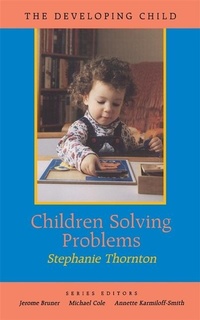
Children Solving Problems
Published on 14. July 1998
Book
Paperback/Softback
154 pages
978-0-674-11624-5 (ISBN)
Description
A one-year-old attempting to build a tower of blocks may bring the pile crashing down, yet her five-year-old sister accomplishes this task with ease. Why do young children have difficulty with problems that present no real challenge to older children? How do problem-solving skills develop? In Children Solving Problems, Stephanie Thornton surveys recent research from a broad range of perspectives in order to explore this important question.
What Thornton finds may come as a surprise: successful problem-solving depends less on how smart we are-or, as the pioneering psychologist Jean Piaget claimed, how advanced our skill in logical reasoning is-and more on the factual knowledge we acquire as we learn and interpret cues from the world around us.
Problem-solving skills evolve through experience and dynamic interaction with a problem. But equally important-as the Russian psychologist L. S. Vygotsky proposed-is social interaction. Successful problem-solving is a social process. Sharing problem-solving tasks-with skilled adults and with other children-is vital to a child's growth in expertise and confidence. In problem-solving, confidence can be more important than skill.
In a real sense, problem-solving lies at the heart of what we mean by intelligence. The ability to identify a goal, to work out how to achieve it, and to carry out that plan is the essence of every intelligent activity. Could it be, Thornton suggests, that problem-solving processes provide the fundamental machinery for cognitive development? In Children Solving Problems she synthesizes the dramatic insights and findings of post-Piagetian research and sets the agenda for the next stage in understanding the varied phenomena of children's problem-solving.
What Thornton finds may come as a surprise: successful problem-solving depends less on how smart we are-or, as the pioneering psychologist Jean Piaget claimed, how advanced our skill in logical reasoning is-and more on the factual knowledge we acquire as we learn and interpret cues from the world around us.
Problem-solving skills evolve through experience and dynamic interaction with a problem. But equally important-as the Russian psychologist L. S. Vygotsky proposed-is social interaction. Successful problem-solving is a social process. Sharing problem-solving tasks-with skilled adults and with other children-is vital to a child's growth in expertise and confidence. In problem-solving, confidence can be more important than skill.
In a real sense, problem-solving lies at the heart of what we mean by intelligence. The ability to identify a goal, to work out how to achieve it, and to carry out that plan is the essence of every intelligent activity. Could it be, Thornton suggests, that problem-solving processes provide the fundamental machinery for cognitive development? In Children Solving Problems she synthesizes the dramatic insights and findings of post-Piagetian research and sets the agenda for the next stage in understanding the varied phenomena of children's problem-solving.
Reviews / Votes
[There is] much of value about Thornton's book. In particular, not only does it meet the aim of providing an accessible outline of a major strand of contemporary thinking, but it does so in a manner likely to inspire considerable enthusiasm and interest in its readers. -- A. Tolmie * British Journal of Developmental Psychology * In this short, clearly written book, Thornton synthesizes literature in post-Piagetian research to consider the development of children's problem solving capacities. She suggests that there are multiple variables that contribute to the ease with which children solve problems and the sophistication of the strategies they employ. * Harvard Educational Review * The synopsis of research since the 1970s provided here constitutes a valid challenge to Piaget's theory that the development of logical skills is fundamental to the ability to solve problems. * Readings * This small, thoughtful volume takes its place with others of similarly high quality in the Developing Child series. * Science Books & Films *More details
Series
Language
English
Place of publication
Cambridge, Mass
United States
Target group
Professional and scholarly
US School Grade: College Graduate Student
Product notice
Paperback (trade)
Unsewn / adhesive bound
Illustrations
26 line illustrations
Dimensions
Height: 207 mm
Width: 133 mm
Thickness: 11 mm
Weight
213 gr
ISBN-13
978-0-674-11624-5 (9780674116245)
Copyright in bibliographic data and cover images is held by Nielsen Book Services Limited or by the publishers or by their respective licensors: all rights reserved.
Schweitzer Classification
Other editions
Additional editions
Stephanie Thornton
Children Solving Problems
E-Book
07/2009
Harvard University Press
€26.49
Available for download
Person
Stephanie Thornton is Lecturer in Psychology at the University of Sussex.
Content
1. Why Children's Problem-Solving Is Interesting 2. A Historical Perspective on Children's Problem-Solving: Inference and the Development of Logic 3. Conceptual Tools for Solving Problems: Inherent Skills and Information 4. Working through a Problem and Discovering New Strategies 5. The Social Context of Children's Problem-Solving 6. Conclusions Notes Suggested Reading Credits Index