

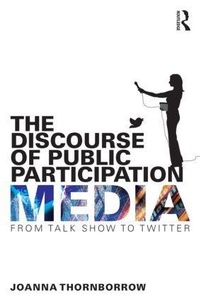
The Discourse of Public Participation Media
From talk show to Twitter
1st Edition
Published on 24. November 2014
Book
Paperback/Softback
210 pages
978-1-138-02495-3 (ISBN)
Description
The Discourse of Public Participation Media takes a fresh look at what 'ordinary' people are doing on air - what they say, and how and where they get to say it.
Using techniques of discourse analysis to explore the construction of participant identities in a range of different public participation genres, Joanna Thornborrow argues that the role of the 'ordinary' person in these media environments is frequently anything but.
Tracing the development of discourses of public participation media, the book focusses particularly on the 1990s onwards when broadcasting was expanding rapidly: the rise of the TV talk show, increasing formats for public participation in broadcast debate and discussion, and the explosion of reality TV in the first decade of the 21st century. During this period, traditional broadcasting has also had to move with the times and incorporate mobile and web-based communication technologies as new platforms for public access and participation - text and email as well as the telephone - and an audience that moves out of the studio and into the online spaces of chat rooms, comment forums and the 'twitterverse'.
This original study examines the shifting discourses of public engagement and participation resulting from these new forms of communication, making it an ideal companion for students of communication, media and cultural studies, media discourse, broadcast talk and social interaction.
Using techniques of discourse analysis to explore the construction of participant identities in a range of different public participation genres, Joanna Thornborrow argues that the role of the 'ordinary' person in these media environments is frequently anything but.
Tracing the development of discourses of public participation media, the book focusses particularly on the 1990s onwards when broadcasting was expanding rapidly: the rise of the TV talk show, increasing formats for public participation in broadcast debate and discussion, and the explosion of reality TV in the first decade of the 21st century. During this period, traditional broadcasting has also had to move with the times and incorporate mobile and web-based communication technologies as new platforms for public access and participation - text and email as well as the telephone - and an audience that moves out of the studio and into the online spaces of chat rooms, comment forums and the 'twitterverse'.
This original study examines the shifting discourses of public engagement and participation resulting from these new forms of communication, making it an ideal companion for students of communication, media and cultural studies, media discourse, broadcast talk and social interaction.
More details
Language
English
Place of publication
London
United Kingdom
Publishing group
Taylor & Francis Ltd
Target group
College/higher education
Product notice
Paperback (trade)
Unsewn / adhesive bound
Dimensions
Height: 231 mm
Width: 152 mm
Thickness: 13 mm
Weight
318 gr
ISBN-13
978-1-138-02495-3 (9781138024953)
Copyright in bibliographic data and cover images is held by Nielsen Book Services Limited or by the publishers or by their respective licensors: all rights reserved.
Schweitzer Classification
Other editions
Additional editions
Book
11/2014
1st Edition
Routledge
€207.40
Shipment within 10-20 days
E-Book
11/2014
1st Edition
Routledge
€64.49
Available for download
E-Book
11/2014
1st Edition
Routledge
€64.49
Available for download
Person
Joanna Thornborrow is Professor of English Language and Linguistics at the University of Western Brittany. She has published widely on forms of media talk and social interaction in edited books and major international journals, and is the author of Power Talk: Language and Interaction in Institutional Discourse (2002).
Content
1. Introduction: Talking on Television and Radio 2. Identity and expertise 3. Performance and the Mediated 'Self' 4. Discourses of Participation: Telling Stories 5. Discourses of Participation: Opinion and Argument 6. Discourses of Participation: Conflict and Judgement 7. Discourses of Participation: Advice and Makeover 8. Conclusions References