

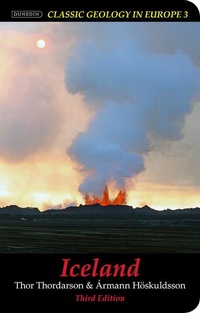
Iceland
3rd Edition
Published on 20. January 2022
Book
Paperback/Softback
280 pages
978-1-78046-092-5 (ISBN)
Description
A concise and authoritative field guide to an exceptional natural laboratory, this title in the Classic Geology in Europe series is an essential companion for those visiting Iceland to observe the Earth in action. Rifting of the crust, volcanic eruptions and glacial activity are among a host of processes and features to be observed in this fascinating land.
Nowhere else on Earth is the volcanic and tectonic architecture of seafloor rifts better exposed. Large icecaps and extensive river systems grind down the volcanic pile at rapid rates, dispersing and forming thick sequences of sediments. These formations are further modified by the pounding waves of the North Atlantic causing intriguing landforms that exhibit an intricate balance between the construction and erosion of land. Iceland is the only part of the North Atlantic Large Igneous Province that is still active and the only place on Earth where the construction of such provinces can be observed directly. As such, it is a window into the formation of proto-continents early in the Earth's history. For the past seven million years Iceland has been situated at the boundary of major air and ocean masses and has consequently been exposed to extreme climate changes. The effects of the climate on the rock-forming processes are clearly illustrated by diverse sedimentary and volcanic successions and by the wide range of volcanic landforms formed in sub-aqueous to sub-aerial environments; each succession reflecting the characteristics of internal and external processes.
Icelandic culture cannot be fully comprehended without understanding its geology. Thus the book will interest not only student, amateur and professional geologists but also others attracted by the natural environment and seeking a deeper understanding of what makes Iceland the unique place that it is.
Nowhere else on Earth is the volcanic and tectonic architecture of seafloor rifts better exposed. Large icecaps and extensive river systems grind down the volcanic pile at rapid rates, dispersing and forming thick sequences of sediments. These formations are further modified by the pounding waves of the North Atlantic causing intriguing landforms that exhibit an intricate balance between the construction and erosion of land. Iceland is the only part of the North Atlantic Large Igneous Province that is still active and the only place on Earth where the construction of such provinces can be observed directly. As such, it is a window into the formation of proto-continents early in the Earth's history. For the past seven million years Iceland has been situated at the boundary of major air and ocean masses and has consequently been exposed to extreme climate changes. The effects of the climate on the rock-forming processes are clearly illustrated by diverse sedimentary and volcanic successions and by the wide range of volcanic landforms formed in sub-aqueous to sub-aerial environments; each succession reflecting the characteristics of internal and external processes.
Icelandic culture cannot be fully comprehended without understanding its geology. Thus the book will interest not only student, amateur and professional geologists but also others attracted by the natural environment and seeking a deeper understanding of what makes Iceland the unique place that it is.
Reviews / Votes
This edition includes a new section describing the 2014-15 eruption at Holuhraun, and publication was delayed from March 2021 to include a brief addendum on the Fagradalsfjall eruption at the Reykjanes Peninsula.The first chapter gives a comprehensive and succinct overview of the geology of Iceland in its unique tectonic and hot spot setting on the Mid-Atlantic Ridge. The chapter describes the geological framework of Iceland's volcanic zones and belts, the volcanism and its products, volcanic architecture, as well as the products of glacial activity, sedimentary processes and the stratigraphical succession of 18 million years of geological history...
I saw no mention of a translator and I am totally in awe of the authors who can write so lucidly in what I assume is for them, a foreign language. I enjoyed reading the book and am inspired to get on a plane and go visit these places again, Classic Geology in Europe: Iceland in hand.
Proceedings of the OUGS
More details
Series
Edition
3rd Revised edition
Language
English
Place of publication
Liverpool
United Kingdom
Target group
College/higher education
Edition type
Revised edition
Illustrations
colour illustrations throughout
Dimensions
Height: 214 mm
Width: 137 mm
Thickness: 20 mm
Weight
506 gr
ISBN-13
978-1-78046-092-5 (9781780460925)
Copyright in bibliographic data and cover images is held by Nielsen Book Services Limited or by the publishers or by their respective licensors: all rights reserved.
Schweitzer Classification
Other editions

Persons
Thor Thordarson obtained his PhD at the University of Hawaii at Manoa. He is now at the Faculty of Earth Sciences, University of Iceland having worked previously at the University of Edinburgh, the University of Hawaii at Manoa, CSIRO in Western Australia, the IGNS Volcanology Group in New Zealand, and the Nordic Volcanological Institute, Reykjavik. Armann Hoeskuldsson gained his PhD at l'Universite Blaise Pascal, Clermont-Ferrand. He is now with the Institute of Earth Sciences, University of Iceland and was previously the Director of the South Iceland Institute of Natural History in Vestmannaeyjar.
Content
Preface. Acknowledgements. Introduction. Travel in Iceland. Pronunciation. The geology of Iceland.
Introduction: Geological setting: a global perspective; Geological framework; Volcanism; Tertiary, Quaternary, Holocene. The southwest: General overview; Greater Reykjavik; Reykjanes-Grindavik-Kleifarvatn. The south: General overview; ?ingvellir-Geysir-Gullfoss; Hreppar-?jorsardalur-Hekla. Vestmannaeyjar (the Westman Islands): General overview; Heimaey; The 1963-7 Surtsey eruption. The central south: General overview; Eyjafjallajoekull and Myrdalur; The Fire Districts. The southeast and east: General overview; Su?ursveit-Lon-Alftafjoer?u; The eastern fjords. The northeast: General overview: Joekulsa-Tjoernes; Krafla-Myvatn. The north and northwest: General overview; Fnjoskadalur to Skagi. The west: Snaefellsnes-Borgarfjoer?ur - volcanic zones and rift jumps. The Highlands: General considerations; Askja-Kverkfjoell; Landmannalaugar-Vei?ivoetn. Glossary. Bibliography. Index. GPS coordinates.
Introduction: Geological setting: a global perspective; Geological framework; Volcanism; Tertiary, Quaternary, Holocene. The southwest: General overview; Greater Reykjavik; Reykjanes-Grindavik-Kleifarvatn. The south: General overview; ?ingvellir-Geysir-Gullfoss; Hreppar-?jorsardalur-Hekla. Vestmannaeyjar (the Westman Islands): General overview; Heimaey; The 1963-7 Surtsey eruption. The central south: General overview; Eyjafjallajoekull and Myrdalur; The Fire Districts. The southeast and east: General overview; Su?ursveit-Lon-Alftafjoer?u; The eastern fjords. The northeast: General overview: Joekulsa-Tjoernes; Krafla-Myvatn. The north and northwest: General overview; Fnjoskadalur to Skagi. The west: Snaefellsnes-Borgarfjoer?ur - volcanic zones and rift jumps. The Highlands: General considerations; Askja-Kverkfjoell; Landmannalaugar-Vei?ivoetn. Glossary. Bibliography. Index. GPS coordinates.