

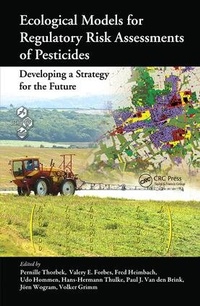
Ecological Models for Regulatory Risk Assessments of Pesticides
Developing a Strategy for the Future
1st Edition
Published on 18. April 2018
Book
Hardback
164 pages
978-1-138-41014-5 (ISBN)
Description
Bringing together more than thirty influential regulators, academics, and industry scientists, this volume provides a coherent, science-based view on ecological modeling for regulatory risk assessments. It discusses the benefits of modeling in the context of registrations, identifies the obstacles that prevent ecological modeling being used routinely in regulatory submissions, and explores the actions needed to overcome these obstacles. The book provides examples of ecological models applied to real-world decision making and presents various up-to-date approaches for assessing the ecological risks of plant protection products.
More details
Language
English
Place of publication
London
United Kingdom
Publishing group
Taylor & Francis Ltd
Target group
College/higher education
Dimensions
Height: 234 mm
Width: 156 mm
Weight
460 gr
ISBN-13
978-1-138-41014-5 (9781138410145)
Copyright in bibliographic data and cover images is held by Nielsen Book Services Limited or by the publishers or by their respective licensors: all rights reserved.
Schweitzer Classification
Other editions
Additional editions
Pernille Thorbek | Valery E. Forbes | Fred Heimbach
Ecological Models for Regulatory Risk Assessments of Pesticides
Developing a Strategy for the Future
Book
11/2009
1st Edition
CRC Press
€160.94
Article not available at the moment
Pernille Thorbek | Valery E. Forbes | Fred Heimbach
Ecological Models for Regulatory Risk Assessments of Pesticides
Developing a Strategy for the Future
E-Book
11/2009
1st Edition
CRC Press
€172.99
Available for download
Persons
Pernille Thorbek is an ecological modeler at Syngenta.Valery E. Forbes is head of the Department of Environmental, Social and Spatial Change and professor of aquatic ecology and ecotoxicology at Roskilde University.Volker Grimm is a senior scientist at the Helmholtz Centre for Environmental Research-UFZ and teaches at the University of Potsdam.Fred Heimbach is a consultant scientist at RIFCon GmbH.Udo Hommen is a senior scientist at the Fraunhofer Institute of Molecular Biology and Applied Ecology.Hans-Hermann Thulke is a senior scientist at the Helmholtz Centre for Environmental Research-UFZ.Paul J. van den Brink is a professor of chemical stress ecology at Wageningen University and a senior research scientist at the Alterra research institute.Jorn Wogram is a biologist with Germany's Federal Environment Agency (UBA).
Editor
Syngenta Ltd., Bracknell, UK
University of Nebraska, Lincoln, USA
RIFCon GmbH, Leichlingen, Germany
Fraunhofer Institute of Molecular Biology and Applied Ecology, Schmallenberg, Germany
Helmholtz Centre for Environmental Research-UFZ, Leipzig, Germany
Wageningen University and Alterra, The Netherlands
Federal Environment Agency (UBA), Dessau-Rosslau, Germany
Helmholtz Centre for Environmental Research-UFZ, Leipzig, Germany
Content
Executive Summary of the LEMTOX Workshop: Lessons Learned and Steps to Be Taken. Introduction to the LEMTOX Workshop. Short Introduction to Ecological Modeling. Regulatory Challenges for the Potential Use of Ecological Models in Risk Assessments of Plant Protection Products. Development and Use of Matrix Population Models for Estimation of Toxicant Effects in Ecological Risk Assessment. MASTEP: An Individual-Based Model to Predict Recovery of Aquatic Invertebrates Following Pesticide Stress. Incorporating Realism into Ecological Risk Assessment- An ABM Approach. Ecological Models Supporting Management of Wildlife Diseases. State of the Art of Ecological Modeling for Pesticide Risk Assessment: A Critical Review. The Role of Ecological Modeling in Risk Assessments Seen from an Academic's Point of View. Potential Role of Population Modeling in the Regulatory Context of Pesticide Authorization. Ecological Modeling: An Industry Perspective. References. Index.