

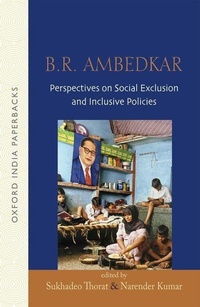
B.R Ambedkar
Perspectives on Social Exclusion and Inclusive Policies
Published on 8. October 2009
Book
Paperback/Softback
404 pages
978-0-19-806350-6 (ISBN)
Description
The contribution of social activist and thinker B.R. Ambedkar in the development of inclusive policies during the British rule and its culmination into the reservation policy in the Constituent Assembly is immense. In this volume original documents, memorandums, and writings by Ambedkar are put together to highlight the process of development in these policies and his thinking. A comprehensive Introduction discusses both the historical context and the present controversy regarding reservations in a proper perspective. The paperback edition carries a new afterword which surveys the recent writings on the subject.
More details
Language
English
Place of publication
New Delhi
India
Target group
College/higher education
Professional and scholarly
Product notice
Paperback (trade)
Unsewn / adhesive bound
Dimensions
Height: 201 mm
Width: 140 mm
Thickness: 28 mm
Weight
340 gr
ISBN-13
978-0-19-806350-6 (9780198063506)
Copyright in bibliographic data and cover images is held by Nielsen Book Services Limited or by the publishers or by their respective licensors: all rights reserved.
Schweitzer Classification
Persons
Sukhadeo Thorat is Chairman, University Grants Commission, New Delhi.
Narender Kumar is Lecturer at Centre for Dalit and Minorities Studies, Jamia Millia Islamia.
Narender Kumar is Lecturer at Centre for Dalit and Minorities Studies, Jamia Millia Islamia.
Content
FOREWORD; PREFACE AND ACKNOWLEDGEMENTS; LIST OF ABBREVIATIONS; INTRODUCTION: HISTORICAL OVERVIEW: 1919-55;; PART I: PROLOGUE TO THE PROBLEM OF INDIAN SOCIETY: SEEKING SOLUTION, 1919-29; INTRODUCTION;; PART II: CONSTITUTIONAL REFORMS: SEEKING POLITICAL REPRESENTATION, 1930-3: INTRODUCTION;; PART III: EXTENDING THE REPRESENTATION: EMPLOYMENT AND EDUCATION, 1934-46: INTRODUCTION;; PART IV: INDIA'S CONSTITUTION: SAFEGUARDS AGAINST SOCIAL DISCRIMINATION AND ECONOMIC EXPLOITATION, 1947-50: INTRODUCTION;