

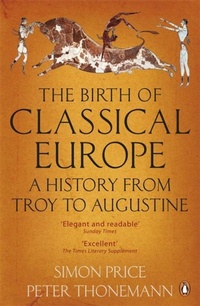
The Birth of Classical Europe
A History from Troy to Augustine
Published on 26. May 2011
Book
Paperback/Softback
416 pages
978-0-14-027485-1 (ISBN)
Description
'The Penguin History of Europe series ... is one of contemporary publishing's great projects' New Statesman
To an extraordinary extent we continue to live in the shadow of the classical world. At every level from languages to calendars to political systems, we are the descendants of a 'classical Europe', using frames of reference created by ancient Mediterranean cultures.
As this consistently fresh and surprising new book makes clear, however, this was no less true for the inhabitants of those classical civilizations themselves, whose myths, history, and buildings were an elaborate engagement with an already old and revered past filled with great leaders and writers, emigrations and battles. Indeed, much of the reason we know so much about the classical past is the obsessive importance it held for so many generations of Greeks and Romans, who interpreted and reinterpreted their changing casts of heroes and villains. Figures such as Alexander the Great and Augustus Caesar loom large in our imaginations today, but they were themselves fascinated by what had preceded them.
The Birth of Classical Europe is therefore both an authoritative history, and also a fascinating attempt to show how our own changing values and interests have shaped our feelings about an era which is by some measures very remote but by others startlingly close.
To an extraordinary extent we continue to live in the shadow of the classical world. At every level from languages to calendars to political systems, we are the descendants of a 'classical Europe', using frames of reference created by ancient Mediterranean cultures.
As this consistently fresh and surprising new book makes clear, however, this was no less true for the inhabitants of those classical civilizations themselves, whose myths, history, and buildings were an elaborate engagement with an already old and revered past filled with great leaders and writers, emigrations and battles. Indeed, much of the reason we know so much about the classical past is the obsessive importance it held for so many generations of Greeks and Romans, who interpreted and reinterpreted their changing casts of heroes and villains. Figures such as Alexander the Great and Augustus Caesar loom large in our imaginations today, but they were themselves fascinated by what had preceded them.
The Birth of Classical Europe is therefore both an authoritative history, and also a fascinating attempt to show how our own changing values and interests have shaped our feelings about an era which is by some measures very remote but by others startlingly close.
Reviews / Votes
The Birth of Classical Europe combines a strong narrative with sophisticated thematic analysis and reflection ... Despite the immense ground covered, there is no impression of the breathlessness and superficiality which one might have thought unavoidable. -- Simon Hornblower * TLS * The Penguin History of Europe series ... is one of contemporary publishing's great projects * New Statesman * With five volumes now out, the Penguin History of Europe series ... is shaping up to be the best general account available, superseding all previous ones * Economist *More details
Language
English
Place of publication
London
United Kingdom
Product notice
Paperback (UK-B)
Dimensions
Height: 197 mm
Width: 131 mm
Thickness: 37 mm
Weight
328 gr
ISBN-13
978-0-14-027485-1 (9780140274851)
Copyright in bibliographic data and cover images is held by Nielsen Book Services Limited or by the publishers or by their respective licensors: all rights reserved.
Schweitzer Classification
Other editions
Additional editions
E-Book
04/2010
1st Edition
Penguin Books Ltd
€14.99
Available for download
Persons
From 1981 to 2008 Simon Price was a Lecturer at the University of Oxford, where he taught Greek and Roman history for Lady Margaret Hall and St Hugh's College. He has written, co-written, or co-edited books on ancient religions and rituals and also co-edited The Greek City from Homer to Alexander.
Peter Thonemann has taught Greek and Roman history at Wadham College, Oxford, since 2007. He has published widely on the history of Asia Minor, and is director of the Monumenta Asiae Minoris Antiqua XI project. His first book, The Maeander, will be published shortly.
Peter Thonemann has taught Greek and Roman history at Wadham College, Oxford, since 2007. He has published widely on the history of Asia Minor, and is director of the Monumenta Asiae Minoris Antiqua XI project. His first book, The Maeander, will be published shortly.