

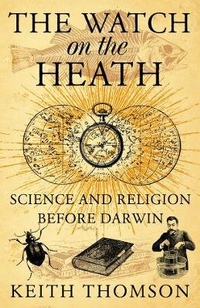
The Watch on the Heath
Science and Religion Before Darwin
Published on 18. April 2005
Book
Hardback
320 pages
978-0-00-713313-0 (ISBN)
Description
Galileo once wrote that 'the Bible tells us how to go to Heaven, but not how the heavens go'. From the Greeks to the present day, thoughtful people have struggled to reconcile the discoveries of science with religious belief and authority.
In the age before Darwin many powerful clerics were also notable scientific scholars and leading scientists were often at least conventionally pious. Observing life ever more closely, an extraordinary generation of English geologists, fossil hunters and naturalists were compelled to accept that their planet was older, more complicated, diverse and cruel than they had previously imagined. Questions about God and the Bible inevitably began to arise. But for these men, unlike for Darwin, science and religion could share a philosophical basis: a careful, rational study of nature, instead of denying God, would confirm that life is, after all, the product of God's unique creation. This belief became known as natural theology.
Its greatest exponent was William Paley but the work of others such as John Ray, Robert Plot, William Whiston, Thomas Burnet, John Woodward, Erasmus Darwin and countless more writing between 1665 and 1800 gives us an extraordinary glimpse into minds at the forefront of an epic enquiry. Taking his title from Paley's famous analogy that as a watch requiried a maker, so nature in all its intricacy had to be the creation of a supreme designer, Keith Thomson's wonderful book brings to life their dilemmas, and is a winning portrayal of intellectuals struggling with their belief systems in an age of revolutionary science.
In the age before Darwin many powerful clerics were also notable scientific scholars and leading scientists were often at least conventionally pious. Observing life ever more closely, an extraordinary generation of English geologists, fossil hunters and naturalists were compelled to accept that their planet was older, more complicated, diverse and cruel than they had previously imagined. Questions about God and the Bible inevitably began to arise. But for these men, unlike for Darwin, science and religion could share a philosophical basis: a careful, rational study of nature, instead of denying God, would confirm that life is, after all, the product of God's unique creation. This belief became known as natural theology.
Its greatest exponent was William Paley but the work of others such as John Ray, Robert Plot, William Whiston, Thomas Burnet, John Woodward, Erasmus Darwin and countless more writing between 1665 and 1800 gives us an extraordinary glimpse into minds at the forefront of an epic enquiry. Taking his title from Paley's famous analogy that as a watch requiried a maker, so nature in all its intricacy had to be the creation of a supreme designer, Keith Thomson's wonderful book brings to life their dilemmas, and is a winning portrayal of intellectuals struggling with their belief systems in an age of revolutionary science.
Reviews / Votes
'Beautifully told...[a] luminously clear account of the relation between faith and science.' Independent on Sunday'Combines his tales of the academic melodrama with scholarly assessment of the growing momentum of evolutionary thought.' Financial Times
More details
Language
English
Place of publication
London
United Kingdom
Publishing group
HarperCollins Publishers
Dimensions
Height: 240 mm
Width: 159 mm
Thickness: 30 mm
Weight
601 gr
ISBN-13
978-0-00-713313-0 (9780007133130)
Copyright in bibliographic data and cover images is held by Nielsen Book Services Limited or by the publishers or by their respective licensors: all rights reserved.
Schweitzer Classification
Person
Keith Thomson has recently retired as Professor of Natural History and Director of the Oxford University Museum. He has previously been Professor of Biology and Dean at Yale University. He has written widely on the history of science, including HMS Beagle: The Story of Darwin's Ship and Living Fossil: The Story of Coelacanth.