

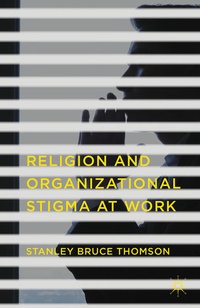
Religion and Organizational Stigma at Work
Published on 9. September 2015
Book
Hardback
XIII, 270 pages
978-1-137-51455-4 (ISBN)
Description
This book uses stigma theory to provide meaningful insight into the coping mechanisms of employees who experience critical and judgmental reactions to their religion in the workplace. Thomson's research synthesizes the various models of invisible diversity management and offers strategies for application at the organizational level.
Reviews / Votes
"This book will be a welcomed resource for individuals, managers and researchers who are seeking to better understand the role of religion in the lives of employees. It will allow the reader, maybe for the first time, to see the perspective, hear the voice and understand the strategic thought process of someone whose religious belief is considered a vital aspect of their human indentity - regardless of where they find themselves, including the workplace." (Timothy Ewest, JBIB Journal of Biblical Integration, Vol. 19, 2016)More details
Edition
1st ed. 2015
Language
English
Place of publication
New York
United States
Target group
Professional and scholarly
Product notice
sewn/stitched
Cloth over boards
With dust jacket
Illustrations
XIII, 270 p.
Dimensions
Height: 218 mm
Width: 140 mm
Thickness: 20 mm
Weight
454 gr
ISBN-13
978-1-137-51455-4 (9781137514554)
DOI
10.1057/9781137514561
Schweitzer Classification
Other editions
Additional editions
Stanley Bruce Thomson
Religion and Organizational Stigma at Work
E-Book
04/2016
Palgrave MacMillan
€96.29
Available for download

Stanley Bruce Thomson
Religion and Organizational Stigma at Work
Book
01/2014
Palgrave MacMillan
€112.34
The article will not be published
Person
S. Bruce Thomson is Sessional Lecturer at University of Alberta, Canada and MacEwan University, Canada.
Content
1. Introduction - Why religion? Why stigma theory? 2. Review of the literature - Religion at work 3. How aware are we? Perceptions of employees of religious diversity 4. What do we do? Strategies for dealing with religion at work. 5. Perceived organizational diversity management strategies 6. Effect of national attitudes on religion at work 7. Conclusion - reflection, areas of research and recommendations