

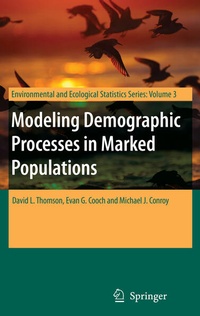
Modeling Demographic Processes in Marked Populations
Published on 2. December 2008
Book
Hardback
XXIV, 1132 pages
978-0-387-78150-1 (ISBN)
Description
Demography can be considered the key to understanding much of biology. It is the demographic processes of birth and death which govern the spread of populations through environmentsand the spread of genes through populations. An understa- ing of demographycan yield not only an understanding of population size and p- ulation change, it can help us to understand the form and function of life histories; whenorganismsmature,whentheybreed,and whentheydie. Demographicinsights allow us to see how populations function, how they interact with their changing environment, and how they adapt. The analysis of demographic processes in free-living organisms is however no simple task and involves considerable challenges in observation and analysis. Some 20yearsago,therewasaconcertedefforttopromoteinter-disciplinarycollaboration between biologists and statisticians to address these challenges and thereby to f- ther our understanding of demographic processes in natural populations. Although many diverse organisms can be studied in the wild, birds have proved particularly amenable with large numbers being marked and followed by large networks of - servers.
Itwas nocoincidencethenthatthe EuropeanUnionforBird Ringing(EUR- ING) played a leading role in these initiatives, teaming up in the mid-1980swith the Mathematical Ecology Group of the Biometric Society, and the British Ecological Society, to bring together experts from diverse ?elds to address the challenges in hand. Twenty years on, progresshas been considerable and we now have signi?cant insights into demographic processes thanks to the wide range of quantitative tools and systematically collected datasets which have been built up over this period.
Itwas nocoincidencethenthatthe EuropeanUnionforBird Ringing(EUR- ING) played a leading role in these initiatives, teaming up in the mid-1980swith the Mathematical Ecology Group of the Biometric Society, and the British Ecological Society, to bring together experts from diverse ?elds to address the challenges in hand. Twenty years on, progresshas been considerable and we now have signi?cant insights into demographic processes thanks to the wide range of quantitative tools and systematically collected datasets which have been built up over this period.
More details
Series
Edition
2009 ed.
Language
English
Place of publication
New York
United States
Target group
Professional and scholarly
Research
Product notice
sewn/stitched
Cloth over boards
Illustrations
XXIV, 1132 p.
Dimensions
Height: 234 mm
Width: 157 mm
Thickness: 56 mm
Weight
1701 gr
ISBN-13
978-0-387-78150-1 (9780387781501)
DOI
10.1007/978-0-387-78151-8
Schweitzer Classification
Other editions
Additional editions
David L. Thomson | Evan G. Cooch | Michael J. Conroy
Modeling Demographic Processes in Marked Populations
Book
08/2016
Springer
€213.99
Shipment within 15-20 days
David L. Thomson | Evan G. Cooch | Michael J. Conroy
Modeling Demographic Processes in Marked Populations
Environmental and Ecological Statistics
E-Book
12/2008
1st Edition
Springer
€213.99
Available for download
Content
Population Dynamics - Growth, Density-Dependence and Decomposing ?.- Evolutionary Ecology.- Abundance Estimation - Direct Methods, Proxies, Occupancy Models and Point Count Data.- Dispersal, Movement and Migration - Methods and Multi-State Models.- Wildlife and Conservation Management.- Combing Sources of Information - Kalman Filters, Matrix Methods and Joint Likelihoods.- Bayesian Applications - Advances, Random Effects and Hierarchical Models.- The Robust Design - Sampling, Applications and Advances.- State Uncertainty - Assignmant Error and Unobservable States.- New Software Developments for Modeling Demographic Processes.- Open Forum.