

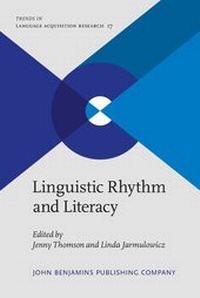
Linguistic Rhythm and Literacy
Published on 10. March 2016
Book
Hardback
286 pages
978-90-272-4407-9 (ISBN)
Description
The intersection of sound processing, speech production, and literacy is a promising and growing area of study. This volume showcases recent empirical research exploring the association between linguistic rhythm and reading. Linguistic rhythm does not easily assume a single definition, which is part of the motivation for this volume, and subsumes constructs including suprasegmental phonology, prosody, intonation and stress. The twelve papers collected here are the product of a gathering of like-minded researchers from the disciplines of linguistics, psycholinguistics, developmental psychology, cognitive neuroscience and education. The resulting chapters cover topics including the following: developmental interactions between linguistic rhythm and reading and spelling, relationships between rhythm and dyslexia, and cross-linguistic variation in the relationship between lexical stress and orthography. This book will be of interest to researchers and graduate students in the fields of linguistics, human communication, developmental psychology, cognitive psychology and literacy.
More details
Series
Language
English
Place of publication
Amsterdam
Netherlands
Target group
College/higher education
Professional and scholarly
Illustrations
+ index
Weight
655 gr
ISBN-13
978-90-272-4407-9 (9789027244079)
Copyright in bibliographic data and cover images is held by Nielsen Book Services Limited or by the publishers or by their respective licensors: all rights reserved.
Schweitzer Classification
Other editions
Additional editions
Jenny Thomson | Linda Jarmulowicz
Linguistic Rhythm and Literacy
E-Book
02/2016
1st Edition
John Benjamins Publishing Company
€118.99
Available for download
Persons
Content
1. Introduction; 2. Prosodic Sensitivity Literacy; 3. The Contributions of Prosodic and Phonological Awareness to Reading: A Review (by Wade-Woolley, Lesly); 4. Chapter 2. Suprasegmental Phonology and Early Reading Development: Examining the Relative Contribution of Sensitivity to Stress, Intonation, and Timing (by Holliman, Andrew J.); 5. Chapter 3. Which Prosodic Skills are Related to Reading Ability in Adulthood? (by Mundy, Ian R.); 6. Chapter 4. Towards a Speech Rhythm-Based Reading Intervention (by Harrison, Emily); 7. Chapter 5. The Neural Basis of Speech Rhythm Perception (by Thomson, Jenny); 8. Chapter 6. Speech Rhythm and Temporal Structure: Converging Perspectives? (by Goswami, Usha); 9. Prosodic Productivity Literacy; 10. Chapter 7. Word Stress Competence and Literacy in Dutch Children with a Family Risk of Dyslexia and Children with Dyslexia (by Bree, Elise de); 11. Chapter 8. Stress Production in Derived English Words as a Developmental Window (by Jarmulowicz, Linda); 12. Chapter 9. Development of Reading Prosody and its Assessment (by Schwanenflugel, Paula J.); 13. Prosody and Orthography; 14. Chapter 10. Cross-Linguistic Evidence for Probabilistic Orthographic Cues to Lexical Stress (by Monaghan, Padraic); 15. Chapter 11. From Diacritics to the Mental Lexicon: Where is the Stress? (by Protopapas, Athanassios); 16. Chapter 12. Prosodic Skills and Literacy Acquisition in Spanish (by Gutierrez-Palma, Nicolas)