

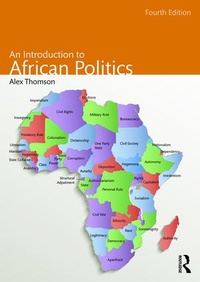
An Introduction to African Politics
4th Edition
Published on 2. May 2016
Book
Paperback/Softback
298 pages
978-1-138-78284-6 (ISBN)
Description
The fourth edition of An Introduction to African Politics is an ideal textbook for those new to the study of this fascinating continent. It gets to the heart of the politics of this part of the world. How is modern Africa still influenced by its colonial past? How do strong ethnic and religious identities on the continent affect government? Why has the military been so influential? How does African democracy differ from democracy in the West? These are the sorts of question tackled by the book. The result is a textbook that identifies the essential features of African politics, allowing students to grasp the recurring political patterns that have dominated this continent since independence.
Key features include:
Thematically organised, with individual chapters exploring issues such as colonialism, ethnicity, nationalism, religion, social class, ideology, legitimacy, authority, sovereignty and democracy.
Identifies key recurrent themes such as the competitive relationships between the African state, its civil society and external interests.
Contains useful boxed case studies at the end of each chapter, including: Kenya, Tanzania, Nigeria, Botswana, Cote d'Ivoire, Uganda, Somalia, Ghana, Democratic Republic of the Congo and Zimbabwe.
Each chapter concludes with key terms and definitions, as well as questions and advice on further reading.
This textbook is essential reading for students seeking an accessible introduction to the complex social relationships and events that characterise the politics of post-colonial Africa.
Key features include:
Thematically organised, with individual chapters exploring issues such as colonialism, ethnicity, nationalism, religion, social class, ideology, legitimacy, authority, sovereignty and democracy.
Identifies key recurrent themes such as the competitive relationships between the African state, its civil society and external interests.
Contains useful boxed case studies at the end of each chapter, including: Kenya, Tanzania, Nigeria, Botswana, Cote d'Ivoire, Uganda, Somalia, Ghana, Democratic Republic of the Congo and Zimbabwe.
Each chapter concludes with key terms and definitions, as well as questions and advice on further reading.
This textbook is essential reading for students seeking an accessible introduction to the complex social relationships and events that characterise the politics of post-colonial Africa.
Reviews / Votes
Reviews of previous editions of An Introduction of African Politics:"No student of Sub-Saharan African politics can afford to be without this text. It is, by a quite considerable degree, the best current work in the field." - Andrew Flint, University of Bristol, UK
"... an excellent book of great use for students. It represents a significant contribution to the study of politics in Africa." - Jeff Haynes, London Metropolitan University, UK
This Edition:
"This is a sober and compassionate, hard-headed but evenly-balanced account of African politics. It avoids both the excesses of Afro-pessimism and optimism and strikes a note of deep reflection based on deep investigation. This is a superb and illuminating introduction to the continent which remains the world's worst understood." - Stephen Chan OBE, SOAS University of London, UK
"Alex Thomson's book has become established as the key undergraduate text for the study of African politics. The skilful mix of themes and case studies alongside insightful commentary makes this edition ideal for the teaching of the continent's myriad issues and challenges." - Ian Taylor, University of St Andrews, UK
"Alex Thomson has done it again! Previous versions established An Introduction to African Politics as one of the most accessible and detailed African politics textbooks. This expertly revised and thoroughly updated new edition is most welcome. The book is sufficiently comprehensive and sophisticated in its use of political science theory and concepts to satisfy professors, and it is highly readable, which will appeal to students. This is a fantastic text for courses on African Politics or comparative politics more broadly." - Scott Taylor, Georgetown University, USA.
More details
Edition
4th edition
Language
English
Place of publication
London
United Kingdom
Publishing group
Taylor & Francis Ltd
Target group
College/higher education
Illustrations
21 s/w Abbildungen, 18 s/w Photographien bzw. Rasterbilder, 3 s/w Zeichnungen, 21 s/w Tabellen
21 Tables, black and white; 3 Line drawings, black and white; 18 Halftones, black and white; 21 Illustrations, black and white
Dimensions
Height: 246 mm
Width: 174 mm
Weight
563 gr
ISBN-13
978-1-138-78284-6 (9781138782846)
Copyright in bibliographic data and cover images is held by Nielsen Book Services Limited or by the publishers or by their respective licensors: all rights reserved.
Schweitzer Classification
Other editions
New editions
Alex Thomson
An Introduction to African Politics
Book
12/2022
5th Edition
Routledge
€78.20
Shipment within 15-20 days
Additional editions

Alex Thomson
An Introduction to African Politics
Book
04/2016
4th Edition
Routledge
€207.98
Article exhausted; check for reprint
Previous edition
Alex Thomson
An Introduction to African Politics
Book
05/2010
3rd Edition
Routledge
€55.89
Article exhausted; check for reprint
Person
Alex Thomson is a Principal Lecturer of Politics at Coventry University in the United Kingdom. He has taught and published in the area of African Politics for over twenty years.
Content
1. Introduction: state, civil society and external interests 2. History: Africa's pre-colonial and colonial inheritance 3. Ideology: nationalism, socialism, populism and state capitalism 4. Ethnicity and religion: 'tribes', gods and political identity 5. Social class: the search for class politics in Africa 6. Legitimacy: neo-patrimonialism, personal rule and the centralisation of the African state 7. Coercion: military intervention in African politics 8. Sovereignty I: external influences on African politics 9. Sovereignty II: neo-colonialism, structural adjustment and Africa's political economy 10. Authority: the crises of accumulation, governance and state collapse 11. Democracy: re-legitimising the African state? 12. Conclusions: The changing relationship between state, civil society and external interests in the post colonial era