

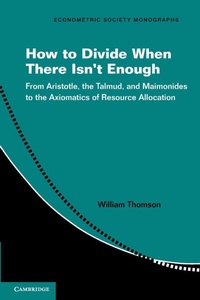
How to Divide When There Isn't Enough
From Aristotle, the Talmud, and Maimonides to the Axiomatics of Resource Allocation
Published on 5. September 2019
Book
Paperback/Softback
504 pages
978-1-316-64644-1 (ISBN)
Description
How to Divide When There Isn't Enough develops a rigorous yet accessible presentation of the state-of-the-art for the adjudication of conflicting claims and the theory of taxation. It covers all aspects one may wish to know about claims problems: the most important rules, the most important axioms, and how these two sets are related. More generally, it also serves as an introduction to the modern theory of economic design, which in the last twenty years has revolutionized many areas of economics, generating a wide range of applicable allocations rules that have improved people's lives in many ways. In developing the theory, the book employs a variety of techniques that will appeal to both experts and non-experts. Compiling decades of research into a single framework, William Thomson provides numerous applications that will open a large number of avenues for future research.
Reviews / Votes
'William Thomson, one of the greatest academic advisors in economics worldwide, and a leading scholar in the field of resource allocation, has been carefully developing this project for more than two decades. I believe the book will be considered a classic right after being published.' Juan D. Moreno-Ternero, Universidad Pablo de Olavide, Spain 'The design of rationing rules has inspired for nearly forty years a fascinating intellectual edifice of axiomatic postulates and mathematical results, reviewed here by the premiere author of that literature. Readers will recognize, or discover, William Thomson's superb pedagogical talent in a text that is comprehensive, self-contained, and luminously clear.' Herve Moulin, Donald J. Robertson Chair of Economics, University of Glasgow 'The folksy title notwithstanding, this is an impressive study of modern economic design. The focus of the book is how best to adjudicate claims on a resource when the sum of those claims exceeds the amount or value of the resource. Thomson (Univ. of Rochester) displays his masterful command of the subject, of which he is certainly a prime architect ... The book's lessons apply to many real-world problems, among them bankruptcy claims, estate division, allocation of water rights, allocation of shares of the global carbon budget, and assignment of telecommunications frequencies ... Thomson intends the book, and the work it summarizes, to provide a conceptual basis that will inform wise/smart societal choices going forward.' K. J. Murphy, Choice '... this book is, simply, a masterpiece. It is highly recommended for the broad audience of mainstream economists and a must read for those interested in normative economics ...' Juan D. Moreno-Ternero, Social Choice and WelfareMore details
Series
Language
English
Place of publication
Cambridge
United Kingdom
Target group
Professional and scholarly
Product notice
Paperback (trade)
Illustrations
Worked examples or Exercises; 3 Tables, black and white; 170 Line drawings, black and white
Dimensions
Height: 226 mm
Width: 151 mm
Thickness: 30 mm
Weight
741 gr
ISBN-13
978-1-316-64644-1 (9781316646441)
Copyright in bibliographic data and cover images is held by Nielsen Book Services Limited or by the publishers or by their respective licensors: all rights reserved.
Schweitzer Classification
Other editions
Additional editions
William Thomson
How to Divide When There Isn't Enough
From Aristotle, the Talmud, and Maimonides to the Axiomatics of Resource Allocation
Book
09/2019
Cambridge University Press
€181.10
Article not available at the moment
Person
William Thomson is the Elmer Milliman Professor of Economics at the University of Rochester, New York. He is the author of several books including A Guide for the Young Economist (2011) which has appeared in four translations, and over one hundred articles. In 2001, he won the University Award for Excellence in Graduate Teaching at the University of Rochester. He is a Fellow of the Econometric Society, the Society for Economic Theory, and the Game Theory Society.
Content
1. Introduction; 2. Inventory of division rules; 3. Basic properties of division rules; 4. Monotonicity properties; 5. Claims truncation invariance and minimal rights first; 6. Composition down and composition up; 7. Duality; 8. Other invariance properties; 9. Operators; 10. Variable-population model: consistency and related properties; 11. Constructing consistent extensions of two-claimant rules; 12. Variable-population model: other properties; 13. Ranking awards vectors and ranking rules; 14. Modeling claims problems as games; 15. Variants and generalizations of the base model; 16. Summary graphs and tables; 17. Appendices.