

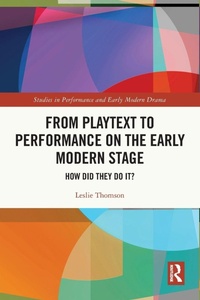
From Playtext to Performance on the Early Modern Stage
How Did They Do It?
1st Edition
Published on 29. January 2024
Book
Paperback/Softback
208 pages
978-1-032-27809-4 (ISBN)
Description
This book reconsiders the evidence for what we know (or think we know) about early modern performance conditions.
This study encourages a new recognition and treatment of certain aspects of the plays as evidence - and demonstrates the significance of the implications of that new information. This book is also an assessment of the competing narratives about the processes involved in early modern performance: about the status of manuscript playbooks, about the parts that players memorized, about the functions of the bookkeeper, about casting, about prompting, and about rehearsal practices. Leslie Thomson investigates the bases for the interdependent beliefs that an early modern player relied only on his part to prepare for a performance, that rehearsal was minimal, and that a bookkeeper compensated for these circumstances by prompting any player who was "out of his part." By focusing on often ignored (or downplayed) requirements and challenges of early modern play texts, Thomson provides evidence for answers that will foster a more nuanced and thorough understanding of original performance practices. That will, in turn, influence how we read, study, and edit the plays.
This exploration will be of great interest to theatre and performance researchers, graduate students, teachers of early modern drama at the undergraduate and graduate levels, performers, directors, editors.
This study encourages a new recognition and treatment of certain aspects of the plays as evidence - and demonstrates the significance of the implications of that new information. This book is also an assessment of the competing narratives about the processes involved in early modern performance: about the status of manuscript playbooks, about the parts that players memorized, about the functions of the bookkeeper, about casting, about prompting, and about rehearsal practices. Leslie Thomson investigates the bases for the interdependent beliefs that an early modern player relied only on his part to prepare for a performance, that rehearsal was minimal, and that a bookkeeper compensated for these circumstances by prompting any player who was "out of his part." By focusing on often ignored (or downplayed) requirements and challenges of early modern play texts, Thomson provides evidence for answers that will foster a more nuanced and thorough understanding of original performance practices. That will, in turn, influence how we read, study, and edit the plays.
This exploration will be of great interest to theatre and performance researchers, graduate students, teachers of early modern drama at the undergraduate and graduate levels, performers, directors, editors.
More details
Series
Language
English
Place of publication
London
United Kingdom
Publishing group
Taylor & Francis Ltd
Dimensions
Height: 234 mm
Width: 156 mm
Thickness: 12 mm
Weight
336 gr
ISBN-13
978-1-032-27809-4 (9781032278094)
Copyright in bibliographic data and cover images is held by Nielsen Book Services Limited or by the publishers or by their respective licensors: all rights reserved.
Schweitzer Classification
Other editions
Additional editions
E-Book
07/2022
1st Edition
Routledge
€55.49
Available for download
E-Book
07/2022
1st Edition
Routledge
€55.49
Available for download
Book
07/2022
1st Edition
Routledge
€206.20
Shipment within 10-20 days
Person
Leslie Thomson, professor Emeritus of English at the University of Toronto, has published widely on various aspects of early modern stage directions and staging. She is co-author (with Alan C. Dessen) of A Dictionary of Stage Directions in English Drama, 1580-1642 and editor of Anything for a Quiet Life, in The Collected Works of Thomas Middleton. Her book, Discoveries on the Early Modern Stage: Contexts and Conventions, was published in 2018.
Content
Introduction
Part I: Pre-Performance
Chapter 1: Evidence and Theories
Chapter 2: Rehearsal Reconsidered
Part II: In-Performance
Chapter 3: Pronouns in Action
Chapter 4: Uncued Actions
Chapter 5: Staging Asides
Chapter 6: Dumb Shows on Stage
Chapter 7: Doubling and Disguise
Chapter 8: Large Properties Off and On Stage
Conclusion
Index
Part I: Pre-Performance
Chapter 1: Evidence and Theories
Chapter 2: Rehearsal Reconsidered
Part II: In-Performance
Chapter 3: Pronouns in Action
Chapter 4: Uncued Actions
Chapter 5: Staging Asides
Chapter 6: Dumb Shows on Stage
Chapter 7: Doubling and Disguise
Chapter 8: Large Properties Off and On Stage
Conclusion
Index