

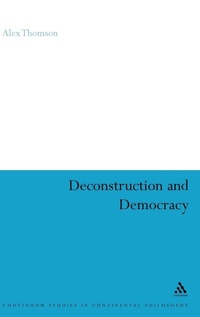
Deconstruction and Democracy
Published on 15. February 2005
Book
Hardback
238 pages
978-0-8264-7577-0 (ISBN)
Description
Derrida's claim that 'without deconstruction there can be no responsible political thought' is one of his most provocative, and one that even his most vocal admirers have been reluctant to endorse fully. Deconstruction and Democracy evaluates and substantiates Derrida's assertion, assessing the importance of this eminent contemporary philosopher's work for political thought. From the early 1980s onwards, Derrida has addressed political subjects more and more explicitly; here Alex Thomson argues that the time has come for a fresh understanding of deconstruction -- one that acknowledges its relevance for, and potential contribution to, political thinking. The book provides cogent analysis and exegesis of Derrida's often rather abstruse and impenetrable political writings; explores the implications for political theory and practice of Derrida's work; and brings Derrida's work into dialogue with other major strands of contemporary political thought.
Deconstruction and Democracy is the clearest and most detailed engagement available with the politics of deconstruction, and is a major contribution to scholarship on the later work of Jacques Derrida, most notably his Politics of Friendship.
Deconstruction and Democracy is the clearest and most detailed engagement available with the politics of deconstruction, and is a major contribution to scholarship on the later work of Jacques Derrida, most notably his Politics of Friendship.
Reviews / Votes
"The greatest achievement of Thomson's book lies in its structure...Alex Thomson shows here a great capacity of overcoming his intellectual doubts toward the Derridean project thanks to his unconstrained belief in its intrinsic value and unspoken intentions. - Alex Cistelecan, Metapsychology, Vol. 12 No. 27, July 1st, 2008 -- Alex Cistelecan "Thomson offers a detailed engagement with Derrida's work and the arguments of Derrida's critics. As a primer on the voluminous and often obscure body of work developed by a philosopher whose works have been widely influential, reaching from philosophy to literary criticism, cultural studies, sociology, and beyond, Deconstruction and Democracy offers a useful and accessible interdisciplinary resource." -Jeff Shantz, Philosophy in Review 'Thomson's book is a welcome event. I would recommend it to those seeking an introduction to Derrida on politics as well as to the adept who stand to benefit from its many interpretations and its cross-fertilizing illuminations.' -- Matthias Fritsch * Notre Dame Philosophical Reviews *More details
Series
Language
English
Place of publication
London
United Kingdom
Publishing group
Bloomsbury Publishing PLC
Target group
Professional and scholarly
Dimensions
Height: 240 mm
Width: 161 mm
Thickness: 18 mm
Weight
529 gr
ISBN-13
978-0-8264-7577-0 (9780826475770)
Copyright in bibliographic data and cover images is held by Nielsen Book Services Limited or by the publishers or by their respective licensors: all rights reserved.
Schweitzer Classification
Other editions
Additional editions
Alex Thomson
Deconstruction and Democracy
E-Book
02/2005
1st Edition
Continuum International Publishing Group Ltd.
€71.99
Available for download
Person
Alex Thomson is a lecturer in English at the University of Glasgow. He is the author of two forthcoming Continuum books: Adorno: A Guide for the Perplexed and Hegel and Critical Theory.
Content
Introduction: The Political Problem of Deconstruction; Part One: Democracy and Deconstruction; 1. No Democracy Without Deconstruction? 2. Deconstruction and Liberal Democracy; 3. Deconstruction and Radical Democracy; Part Two: Deconstruction as Political Practice; 4. The Politics of Exemplarity; 5. Deconstruction in Practice I: Derrida and Heidegger; 6. Deconstruction in Practice II: Politics Beyond Politics; Part Three: Politics Against Ethics; 7. Deconstruction Against Ethics: Derrida and Levinas; 8. Against Community; Part Four: Deconstruction and Political Theory; 9. The Spectrality of Politics: Derrida and Schmitt; 10. The Politics of Spectrality; 11. Deconstruction as Political Theory