

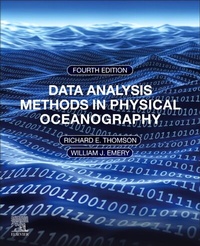
Data Analysis Methods in Physical Oceanography
Fourth Edition
4th Edition
Published on 30. July 2024
Book
Paperback/Softback
890 pages
978-0-323-91723-0 (ISBN)
Description
Data Analysis Methods in Physical Oceanography: Fourth Edition provides a practical reference to established and modern data analysis techniques in earth and ocean sciences. In five sections, the book addresses data acquisition and recording, data processing and presentation, statistical methods and error handling, analysis of spatial data fields, and time series analysis methods. The updated edition includes new information on autonomous platforms and new analysis tools such as "deep learning? and convolutional neural networks. A section on extreme value statistics has been added, and the section on wavelet analysis has been expanded.
This book brings together relevant techniques and references recent papers where these techniques have been trialed. In addition, it presents valuable examples using physical oceanography data. For students, the sections on data acquisition are useful for a compilation of all the measurement methods.
This book brings together relevant techniques and references recent papers where these techniques have been trialed. In addition, it presents valuable examples using physical oceanography data. For students, the sections on data acquisition are useful for a compilation of all the measurement methods.
More details
Edition
4th edition
Language
English
Place of publication
United States
Target group
College/higher education
Professional and scholarly
Illustrations
Approx. 300 illustrations (100 in full color)
Dimensions
Height: 276 mm
Width: 216 mm
Weight
2430 gr
ISBN-13
978-0-323-91723-0 (9780323917230)
Copyright in bibliographic data and cover images is held by Nielsen Book Services Limited or by the publishers or by their respective licensors: all rights reserved.
Schweitzer Classification
Other editions
Additional editions
E-Book
07/2024
4th Edition
Elsevier
€51.95
Available for download
Persons
Richard E. Thomson is a researcher in coastal and deep-sea physical oceanography within the Ocean Sciences Division. Coastal oceanographic processes on the continental shelf and slope including coastally trapped waves, upwelling and baroclinic instability; hydrothermal venting and the physics of buoyant plumes; linkage between circulation and zooplankton biomass aggregations at hydrothermal venting sites; analysis and modelling of landslide generated tsunamis; paleoclimate using tree ring records and sediment cores from coastal inlets and basins. William (Bill) Emery worked as a professor in Aerospace Engineering Sciences at the University of Colorado from 1987, prior to which he worked in the University of British Columbia where he created a Satellite Oceanography education/research program. He has authored over 220-refereed publications and 4 textbooks in addition to having given 200 conference papers. He is a fellow of: the IEEE (2002), the American Meteorological Society (2010), the American Astronautical Society (2011) and the American Geophysical Union (2012). He was recently elected to the IEEE TAB Hall of Honor (2020). In 2022 he received the GRSS Fawaz Ulaby Distinguised Achievement Award.
Content
1. Data Acquisition and Recording
2. Data Processing and Presentation
3. Statistical Methods and Error Handling
4. The Spatial Analyses of Data Fields
5. Time-series Analysis Methods
6. Digital Filters
7. Machine Learning Methods
8. Neural networks, convolutional neural networks and deep learning
2. Data Processing and Presentation
3. Statistical Methods and Error Handling
4. The Spatial Analyses of Data Fields
5. Time-series Analysis Methods
6. Digital Filters
7. Machine Learning Methods
8. Neural networks, convolutional neural networks and deep learning