

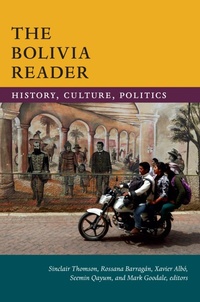
The Bolivia Reader
History, Culture, Politics
Published on 11. July 2018
Book
Paperback/Softback
744 pages
978-0-8223-7152-6 (ISBN)
Description
The Bolivia Reader provides a panoramic view, from antiquity to the present, of the history, culture, and politics of a country known for its ethnic and regional diversity, its rich natural resources and dilemmas of economic development, and its political conflict and creativity. Featuring both classic and little-known texts ranging from fiction, memoir, and poetry to government documents, journalism, and political speeches, the volume challenges stereotypes of Bolivia as a backward nation while offering insights into the country's history of mineral extraction, revolution, labor organizing, indigenous peoples' movements, and much more. Whether documenting Inka rule or Spanish conquest, three centuries at the center of Spanish empire, or the turbulent politics and cultural vibrancy of the national period, these sources-the majority of which appear in English for the first time-foreground the voices of actors from many different walks of life. Unprecedented in scope, The Bolivia Reader illustrates the historical depth and contemporary challenges of Bolivia in all their complexity.
Reviews / Votes
"English-speaking audiences now have a rich resource for in-depth study of Bolivia. It is the perfect book for courses on Andean history and Latin America, as well as hemispheric courses on power, culture, politics, and economy in the Americas. Overall, this book is indispensable for university and college libraries. To put it simply, there is no comparable volume."- Jane Mangan (The Americas) "The field of Bolivian studies has expanded rapidly in the past two decades. . . . Yet, until now, no single book had offered a compelling and comprehensive overview of the forces that have shaped the country into the twenty-first century. The Bolivia Reader performs this difficult task splendidly."
- Kevin A. Young (The Historian)
More details
Series
Language
English
Place of publication
North Carolina
United States
Target group
Professional and scholarly
Product notice
Paperback (trade)
Illustrations
87 illustrations, incl. 10 in color
Dimensions
Height: 236 mm
Width: 157 mm
Thickness: 40 mm
Weight
1043 gr
ISBN-13
978-0-8223-7152-6 (9780822371526)
Copyright in bibliographic data and cover images is held by Nielsen Book Services Limited or by the publishers or by their respective licensors: all rights reserved.
Schweitzer Classification
Other editions
Additional editions
E-Book
06/2018
1st Edition
De Gruyter
€258.99
Available for download
Persons
Sinclair Thomson is Associate Professor of History at New York University.
Rossana BarragAn is Senior Researcher at the International Institute of Social History in the Netherlands.
Xavier AlbO is a Jesuit priest and independent scholar.
Seemin Qayum is an independent scholar.
Mark Goodale is Professor of Cultural and Social Anthropology at the University of Lausanne.
Rossana BarragAn is Senior Researcher at the International Institute of Social History in the Netherlands.
Xavier AlbO is a Jesuit priest and independent scholar.
Seemin Qayum is an independent scholar.
Mark Goodale is Professor of Cultural and Social Anthropology at the University of Lausanne.
Content
Acknowledgments xix
Introduction 1
I. First Peoples and the Making of Andean and Amazonian Space 13
II. States and Conquests in the Andes 45
III. The Rich Mountain 71
IV. From Indian Insurgency to Creole Independence 115
V. Market Circuits and Enclave Extraction 161
VI. The Nation and Political Fragmentation 207
VII. The Nationalization of Natural Resources 257
VIII. Revolutionary Currents 323
IX. Dictatorship and Democracy 407
X. Neoliberalism and Lowland Ascendency 503
XI. Competing Projects for the Future 541
XII. Pachakuti? 623
Suggestions for Further Reading and Viewing 679
Acknowledgment of Copyright and Sources 687
Index 699
Introduction 1
I. First Peoples and the Making of Andean and Amazonian Space 13
II. States and Conquests in the Andes 45
III. The Rich Mountain 71
IV. From Indian Insurgency to Creole Independence 115
V. Market Circuits and Enclave Extraction 161
VI. The Nation and Political Fragmentation 207
VII. The Nationalization of Natural Resources 257
VIII. Revolutionary Currents 323
IX. Dictatorship and Democracy 407
X. Neoliberalism and Lowland Ascendency 503
XI. Competing Projects for the Future 541
XII. Pachakuti? 623
Suggestions for Further Reading and Viewing 679
Acknowledgment of Copyright and Sources 687
Index 699