

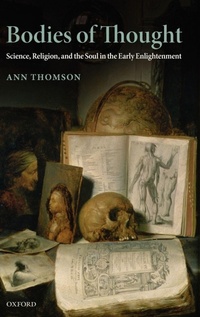
Bodies of Thought
Science, Religion, and the Soul in the Early Enlightenment
Published on 3. July 2008
Book
Hardback
304 pages
978-0-19-923619-0 (ISBN)
Description
Examining the development of a secular, purely material conception of human beings in the early Enlightenment, Bodies of Thought provides a fresh perspective on the intellectual culture of this period, and challenges certain influential interpretations of irreligious thought and the 'Radical Enlightenment'.
Beginning with the debate on the soul in England, in which political and religious concerns were intertwined, and ending with the eruption of materialism onto the public stage in mid-eighteenth-century France, Ann Thomson looks at attempts to explain how the material brain thinks without the need for an immaterial and immortal soul. She shows how this current of thinking fed into the later eighteenth-century 'Natural History of Man', the earlier roots of which have been overlooked by many scholars.
Although much attention has been paid to the atheistic French materialists, their link to the preceding period has been studied only partially, and the current interest in what is called the 'Radical Enlightenment' has served to obscure rather than enlighten this history. By bringing out the importance of both Protestant theological debates and medical thinking in England, and by following the different debates on the soul in Holland and France, this book shows that attempts to find a single coherent strand of radical irreligious thought running through the early Enlightenment, coming to fruition in the second half of the eighteenth century, ignore the multiple channels which composed Enlightenment thinking.
Beginning with the debate on the soul in England, in which political and religious concerns were intertwined, and ending with the eruption of materialism onto the public stage in mid-eighteenth-century France, Ann Thomson looks at attempts to explain how the material brain thinks without the need for an immaterial and immortal soul. She shows how this current of thinking fed into the later eighteenth-century 'Natural History of Man', the earlier roots of which have been overlooked by many scholars.
Although much attention has been paid to the atheistic French materialists, their link to the preceding period has been studied only partially, and the current interest in what is called the 'Radical Enlightenment' has served to obscure rather than enlighten this history. By bringing out the importance of both Protestant theological debates and medical thinking in England, and by following the different debates on the soul in Holland and France, this book shows that attempts to find a single coherent strand of radical irreligious thought running through the early Enlightenment, coming to fruition in the second half of the eighteenth century, ignore the multiple channels which composed Enlightenment thinking.
Reviews / Votes
Thomson's book will provide a wonderful resource for future studies of the doctrines of the soul in the 17th and 18th centuries. * John P. Wright, Reviews in History * Professor Thomson has given us much to ponder in her illuminating study. * William Lamont, English Historical Review *More details
Language
English
Place of publication
Oxford
United Kingdom
Target group
College/higher education
Dimensions
Height: 240 mm
Width: 161 mm
Thickness: 21 mm
Weight
622 gr
ISBN-13
978-0-19-923619-0 (9780199236190)
Copyright in bibliographic data and cover images is held by Nielsen Book Services Limited or by the publishers or by their respective licensors: all rights reserved.
Schweitzer Classification
Person
Content
Preface ; 1. Introduction ; 2. 'The Church in Danger'. Latitudinarians, Socinians, and Hobbists ; 3. Animal Spirits and Living Fibres ; 4. Mortalists and Materialists ; 5. Journalism, Exile, and Clandestinity ; 6. Mid Eighteenth-Century Materialism ; 7. Epilogue : Some Consequences ; Bibliography ; Index