

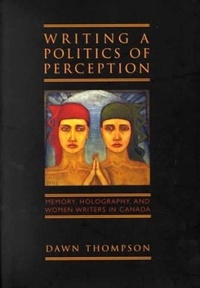
Writing a Politics of Perception
Memory, Holography, and Women Writers in Canada
Will be published approx. on 19. May 2000
Book
Hardback
152 pages
978-0-8020-4365-8 (ISBN)
Description
Writing a Politics of Perception offers new approaches to five novels by women writing in Canada. Dawn Thompson analyses these works through an epistemological theory that shifts critical perspective in surprising ways.
Under consideration are two classics of Canadian literature, Nicole Brossard's "Picture Theory" and Margaret Atwood's "Surfacing", as well as three lesser-known works: Marlene Nourbese Phillip's "Looking for Livingstone", Beatrice Culleton's "In Search of April Raintree", and Regine Robin's "La Quebecoite". Thompson develops a theory of 'holographic memory,' in which texts are performances that invite constant revision, remodelling, and interaction between narrative, memory, and, potentially, reality. This theory is informed by de Lauretis's semiotics of subjectivity, Derrida's memoire radicale, and physicist David Bohm's theory of holographic quantum reality.
Reading these works of Canadian literature through a theory of holographic memory, Thompson successfully combines literary and cultural studies without sacrificing one to the other. She adds to and creates an alliance between feminist, post-colonial, and marxist theory, furthering political work in each of these areas. The interdisciplinary nature of Writing a Politics of Perception will attract scholars and students in a variety of fields, including Canadian and Quebec literature, comparative literature, women's studies, cultural studies, philosophy, and the social sciences.
Under consideration are two classics of Canadian literature, Nicole Brossard's "Picture Theory" and Margaret Atwood's "Surfacing", as well as three lesser-known works: Marlene Nourbese Phillip's "Looking for Livingstone", Beatrice Culleton's "In Search of April Raintree", and Regine Robin's "La Quebecoite". Thompson develops a theory of 'holographic memory,' in which texts are performances that invite constant revision, remodelling, and interaction between narrative, memory, and, potentially, reality. This theory is informed by de Lauretis's semiotics of subjectivity, Derrida's memoire radicale, and physicist David Bohm's theory of holographic quantum reality.
Reading these works of Canadian literature through a theory of holographic memory, Thompson successfully combines literary and cultural studies without sacrificing one to the other. She adds to and creates an alliance between feminist, post-colonial, and marxist theory, furthering political work in each of these areas. The interdisciplinary nature of Writing a Politics of Perception will attract scholars and students in a variety of fields, including Canadian and Quebec literature, comparative literature, women's studies, cultural studies, philosophy, and the social sciences.
More details
Language
English
Place of publication
Toronto
Canada
Product notice
With printed dust jacket
Dimensions
Height: 236 mm
Width: 161 mm
Thickness: 18 mm
Weight
399 gr
ISBN-13
978-0-8020-4365-8 (9780802043658)
Copyright in bibliographic data and cover images is held by Nielsen Book Services Limited or by the publishers or by their respective licensors: all rights reserved.
Schweitzer Classification
Person
Dawn Thompson is an instructor in the Department of English at Malaspina University-College.