

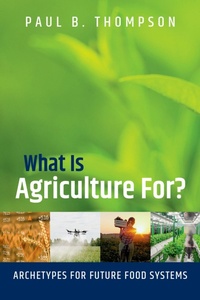
What Is Agriculture For?
Archetypes for Future Food Systems
Published on 8. October 2025
Book
Hardback
304 pages
978-0-19-762575-0 (ISBN)
Description
What Is Agriculture For? describes four contrasting rationales for technical and policy change in agriculture and food systems.
Technological Modernization applies an ethic common to every sector in the industrial economy: production should seek greater efficiencies in order to lower consumer costs and secure adequate supply but should not do so in ways that harm third parties or the environment. The other views single out a feature of agriculture giving it unique moral significance. Sustainable Intensification emphasizes future challenges to the global food supply, and Rural Resilience places special value on the social role of farmers and other producers. Urban Agriculture highlights cities' growing vulnerability to rurally based supply chains. Each perspective leads to distinct policy goals and suggests different priorities for technical innovation. At the same time, the argument for any particular innovation may draw on two of more of these archetypal rationales. The book does greater justice to the complexity of food politics, providing tools for critical evaluation of implicit value commitments and greater understanding of opposing points of view.
Technological Modernization applies an ethic common to every sector in the industrial economy: production should seek greater efficiencies in order to lower consumer costs and secure adequate supply but should not do so in ways that harm third parties or the environment. The other views single out a feature of agriculture giving it unique moral significance. Sustainable Intensification emphasizes future challenges to the global food supply, and Rural Resilience places special value on the social role of farmers and other producers. Urban Agriculture highlights cities' growing vulnerability to rurally based supply chains. Each perspective leads to distinct policy goals and suggests different priorities for technical innovation. At the same time, the argument for any particular innovation may draw on two of more of these archetypal rationales. The book does greater justice to the complexity of food politics, providing tools for critical evaluation of implicit value commitments and greater understanding of opposing points of view.
More details
Language
English
Place of publication
New York
United States
Target group
College/higher education
Dimensions
Height: 165 mm
Width: 242 mm
Thickness: 26 mm
Weight
590 gr
ISBN-13
978-0-19-762575-0 (9780197625750)
Copyright in bibliographic data and cover images is held by Nielsen Book Services Limited or by the publishers or by their respective licensors: all rights reserved.
Schweitzer Classification
Other editions
Additional editions

E-Book
08/2025
OUP eBook
€24.99
Available for download

E-Book
08/2025
OUP eBook
€24.99
Available for download
Person
Paul B. Thompson is Professor Emeritus at Michigan State University where he was the W.K. Kellogg Chair in Agricultural, Food, and Community Ethics from 2003 until 2022. He held the Joyce and Edward E. Brewer Chair in Applied Ethics at Purdue University from 1997 to 2003. All of Thompson's academic positions have been joint appointments between philosophy and each university's college of agriculture and natural resources.
Content
Introduction
Chapter 1: Four Archetypes for Future Food Systems
Chapter 2: Archetypes, Imaginaries, and the Philosophy of Technology
Chapter 3: Technological Modernization and Industrial Agriculture
Chapter 4: Science and Sustainable Intensification
Chapter 5: Rural Resilience and the Food Movement
Chapter 6: Urban Agriculture: The Food Movement Moves On
Chapter 7: Gaps, Overlaps, and the Political Ecology of Food Systems
Chapter 8: Deep Agrarianism
Chapter 1: Four Archetypes for Future Food Systems
Chapter 2: Archetypes, Imaginaries, and the Philosophy of Technology
Chapter 3: Technological Modernization and Industrial Agriculture
Chapter 4: Science and Sustainable Intensification
Chapter 5: Rural Resilience and the Food Movement
Chapter 6: Urban Agriculture: The Food Movement Moves On
Chapter 7: Gaps, Overlaps, and the Political Ecology of Food Systems
Chapter 8: Deep Agrarianism