

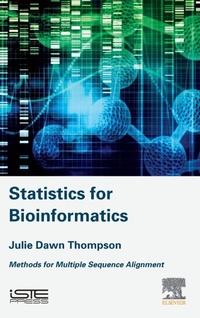
Statistics for Bioinformatics
Methods for Multiple Sequence Alignment
Published on 23. November 2016
Book
Hardback
146 pages
978-1-78548-216-8 (ISBN)
Description
Statistics for Bioinformatics: Methods for Multiple Sequence Alignment provides an in-depth introduction to the most widely used methods and software in the bioinformatics field. With the ever increasing flood of sequence information from genome sequencing projects, multiple sequence alignment has become one of the cornerstones of bioinformatics. Multiple sequence alignments are crucial for genome annotation, as well as the subsequent structural, functional, and evolutionary studies of genes and gene products. Consequently, there has been renewed interest in the development of novel multiple sequence alignment algorithms and more efficient programs.
More details
Language
English
Place of publication
United Kingdom
Target group
Professional and scholarly
Bioinformatics practitioners, Bench biologists with basic bioinformatics experience, those interested in NGS data analysis, Computer scientists, interested in bioinformatics and molecular biology, Practitioners, researchers, clinicians, interested in genomics
Product notice
Laminated cover
Dimensions
Height: 229 mm
Width: 152 mm
Thickness: 10 mm
Weight
371 gr
ISBN-13
978-1-78548-216-8 (9781785482168)
Copyright in bibliographic data and cover images is held by Nielsen Book Services Limited or by the publishers or by their respective licensors: all rights reserved.
Schweitzer Classification
Other editions
Additional editions
E-Book
11/2016
Elsevier
€57.95
Available for download
Person
Julie Dawn Thompson is a Senior Scientist at the French National Center for Scientific Research with expertise in theoretical bioinformatics, data mining, knowledge engineering, integrative bioinformatics and genomics, (LBGI) Stochastic Optimization and Nature inspired Computing (SONIC)
Content
PART I: Fundamental concepts
1. Introduction
2. Multiple sequence applications
PART II: Traditional multiple sequence alignment methods
3. Heuristic approaches
4. Statistical approaches
5. Objective functions
6. Alignment benchmarks
PART III: Large-scale multiple sequence alignment methods
1. Efficient methods for multiple alignment of complete genome sequences
2. Efficient methods for multiple alignment of 1,000's of sequences
3. HPC implementations
4. Alignment quality analysis
1. Introduction
2. Multiple sequence applications
PART II: Traditional multiple sequence alignment methods
3. Heuristic approaches
4. Statistical approaches
5. Objective functions
6. Alignment benchmarks
PART III: Large-scale multiple sequence alignment methods
1. Efficient methods for multiple alignment of complete genome sequences
2. Efficient methods for multiple alignment of 1,000's of sequences
3. HPC implementations
4. Alignment quality analysis